ultimate-guide
Yoga and Meditation for Elderly Pain Management
Table of Contents
- How Yoga and Meditation Address Chronic Pain in Older Adults
- Chair Yoga for Older Adults With Chronic Pain
- Yoga Poses for Back Pain in Older Adults
- Mindfulness Meditation for Chronic Pain
- How Often Older Adults Should Do Yoga
- Effects on Sleep, Mood, Stress, and Overall Well-Being
- Getting Started Safely: Consultation and Condition-Specific Adaptations
- External Sources
- Frequently Asked Questions
Last Updated: October 12, 2026
How Yoga and Meditation Address Chronic Pain in Older Adults
Yoga and meditation for elderly pain management works through the body's own capacity to regulate pain signals. These practices can help older adults move past chronic pain's limitations by shifting how the nervous system processes pain, not by masking symptoms.
With chronic pain, the brain learns to amplify signals over time, a process called sensitization, so the same stimulus that once caused mild discomfort now triggers intense pain.
Pain Perception and the Mind-Body Connection
Pain perception isn't purely physical; it's constructed by your nervous system from sensory input, past experiences, emotions, and attention.
Mindfulness meditation teaches you to observe pain without judgment, changing the emotional charge around it and reducing suffering.
Yoga adds a physical dimension: gentle movement increases blood flow to painful areas, reduces muscle tension, and rebuilds strength and flexibility.
What Research Shows About Yoga and Meditation for Pain Relief
Studies of older adults with osteoarthritis, lower back pain, and fibromyalgia show consistent improvements in pain intensity, mobility, and quality of life with regular practice.
Yoga and meditation reduce inflammatory markers, lower cortisol (which amplifies pain perception), and increase endorphins.
Major medical organizations now recommend mind-body practices as first-line or complementary chronic pain approaches.
Chair Yoga for Older Adults With Chronic Pain
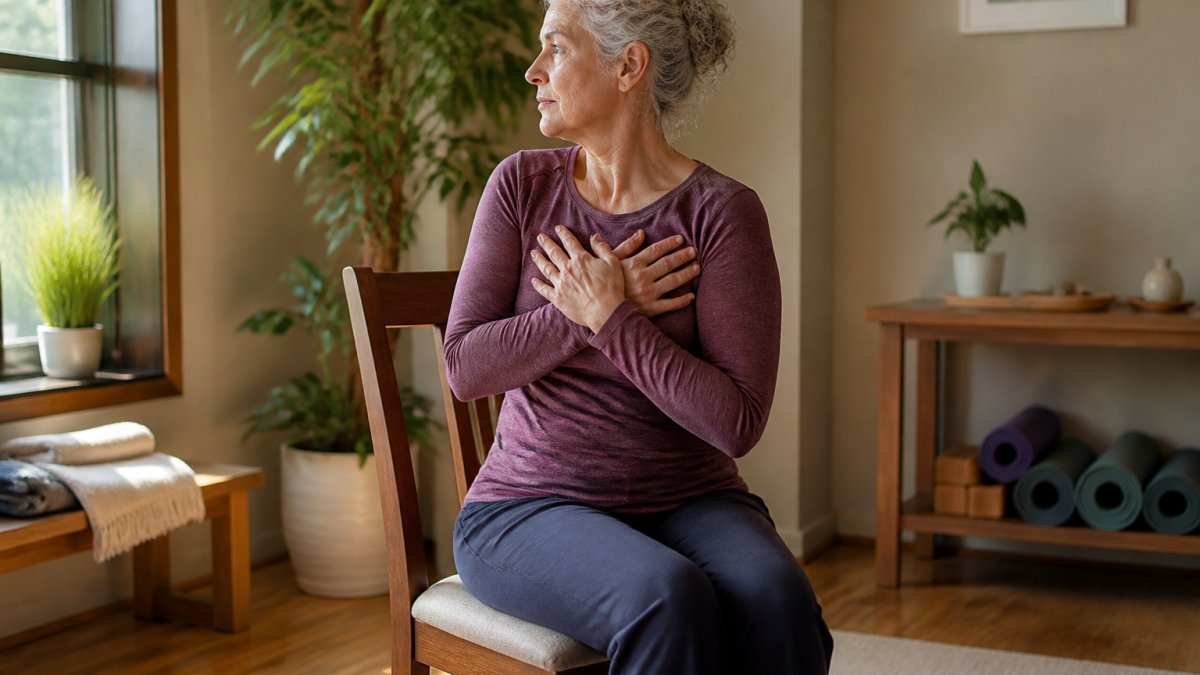
Chair yoga removes the barriers that keep many older adults from yoga's benefits. If you have limited mobility, balance concerns, arthritis, or prefer not to get on the floor, chair yoga delivers the same nervous system benefits and pain relief as traditional yoga, adapted to your body.
Why Chair Yoga Works for Limited Mobility
Chair yoga keeps yoga's core principles, deliberate movement synchronized with breath, body awareness, and gentle stretching, while removing the physical demands that make traditional yoga inaccessible.
Chair yoga builds strength in the stabilizer muscles supporting the spine and joints and increases mobility in the hips, shoulders, and neck. Its gentleness allows daily practice without overuse injury.
Safe Modifications and Alignment Cues
Proper alignment prevents injury and ensures you get the full benefit of each pose:
Seated posture foundation: Sit toward the front of the chair, feet flat and hip-width apart, knees at 90 degrees. Lengthen your spine by imagining a string pulling the crown of your head upward, shoulders relaxed. This neutral position starts every chair yoga movement.
Breathing during movement: Exhale as you move into a stretch or twist. Inhale as you return to neutral.
Range of motion: Move only as far as feels comfortable. Gentle tension is the goal; sharp pain is a stop signal.
Common mistakes: Slouching reduces stretch effectiveness and can increase back pain.
Yoga Poses for Back Pain in Older Adults
Lower back pain is among the most common chronic conditions in older adults and responds well to targeted yoga and meditation for elderly pain management. These poses build core and lower back strength, increase spinal mobility, and reduce the muscle tension that perpetuates pain.
Gentle Postures That Build Strength and Flexibility
Seated Cat-Cow (2-3 minutes): Sit upright.
Seated Spinal Twist (1-2 minutes per side): Sit upright.
Seated Forward Fold (2-3 minutes): Sit with feet flat.
Seated Marching (2-3 minutes): Sit upright and slowly lift one knee toward your chest, then lower it.
Supported Bridge (if you can safely lie down, 1-2 minutes): Lie on your back, knees bent, feet flat.
Common Mistakes to Avoid When Starting a Practice
Practicing through sharp pain: Mild tension during a stretch is normal; sharp, shooting pain is a warning.
Inconsistency: Yoga and meditation for elderly pain management works through regular practice, not occasional sessions.
Skipping the breath: Breath isn't decoration in yoga; it activates the parasympathetic nervous system, which reduces pain.
Pushing too hard too fast: Approaching yoga like exercise and increasing intensity quickly creates soreness and can trigger pain flares.
Mindfulness Meditation for Chronic Pain
Mindfulness meditation trains attention to observe pain without the emotional reaction that amplifies suffering. Unlike distraction, you're not ignoring pain, you're experiencing it with curiosity rather than fear or resistance.
Breath Control and Relaxation Techniques
Breath bridges conscious and unconscious nervous system control. Slowing and deepening it activates the parasympathetic "rest and digest" state that reduces pain signaling.
Basic breathing practice for pain relief (5-10 minutes):
- Sit comfortably with your spine upright.
- Breathe in through your nose for a count of 4.
- Hold the breath for a count of 4.
- Exhale through your mouth for a count of 6.
- Pause for a count of 2.
- Repeat this cycle 8-10 times.
The longer exhale activates relaxation. Practice when pain is mild to moderate, not during acute flares.
Progressive relaxation (10-15 minutes):
Lie or sit comfortably. This teaches your body to recognize and release tension, reducing the muscle guarding that perpetuates chronic pain.
Using Body Awareness to Reduce Pain Intensity
Body scan meditation is a core chronic pain technique: instead of resisting or distracting from pain, you develop precise awareness of where it lives and how it changes.
Body scan meditation for pain (15-20 minutes):
- Lie or sit comfortably.
- Close your eyes and begin breathing naturally.
- Bring attention to your left foot. Notice any sensations, warmth, coolness, tingling, numbness, pain. Don't judge; simply observe.
- Move your attention slowly up your left leg, then to your right leg, then to your torso, arms, neck, and head.
- When you encounter pain, pause there. Breathe into that area. Notice if the pain changes, intensifies, softens, moves, stays the same.
- Continue without resistance. The goal is awareness, not relief (though relief often follows).
Regular practice rewires how the brain processes pain signals. Pain becomes less "this is happening to me" and more "I notice pain in this location," a shift that reduces suffering.
How Often Older Adults Should Do Yoga
Frequency determines results. Occasional yoga provides temporary relief; consistent practice creates lasting change in pain perception and nervous system function.
Frequency, Duration, and Progression
Optimal frequency: Daily practice, even brief (15-20 minutes), produces faster, more substantial results.
Session structure: Warm-up (3-5 minutes) → main practice of poses or meditation (12-20 minutes) → cool-down and relaxation (3-5 minutes).
Intensity progression: Start with gentle, basic poses. After 2-3 weeks, increase duration slightly or add one new pose.
Measuring Progress and Adjusting Your Routine
Tracking progress keeps you motivated and shows what's working. Measure these markers:
| Marker | Baseline | 4 Weeks | 8 Weeks | 12 Weeks |
|---|---|---|---|---|
| Pain intensity (0-10 scale) | Record current | Note change | Note change | Note change |
| Functional capacity (stairs, walking distance, sitting duration) | What's difficult now? | Can you do more? | How much more? | Sustained improvement? |
| Sleep quality (hours, restlessness) | Current pattern | Better? | How much better? | Stable? |
| Medication use (if applicable) | Current dose | Any reduction? | Further reduction? | Sustained lower dose? |
Adjust based on what you observe. If pain is unchanged after 4 weeks, practice more often or try different poses. If improving steadily, maintain your routine. If you've plateaued, add a longer meditation session or a more challenging pose.
Effects on Sleep, Mood, Stress, and Overall Well-Being
Chronic pain doesn't exist in isolation. It disrupts sleep, which worsens pain. It triggers anxiety and depression, which amplify pain perception. Yoga and meditation for elderly pain management addresses this entire system, not just pain sensation.
How Yoga and Meditation Improve Sleep Quality
Pain and insomnia feed each other. Pain keeps you awake; sleep deprivation lowers pain tolerance.
Yoga reduces muscle tension that prevents comfortable positioning; meditation calms racing thoughts. Both lower cortisol, the stress hormone that disrupts sleep architecture.
For many, sleep improvement is often the first noticeable benefit, sometimes within a week of consistent practice.
Stress Reduction, Depression Relief, and Emotional Resilience
Chronic pain is emotionally exhausting: constant discomfort, limitations, and uncertainty produce anxiety and depression, which then amplify pain perception, another vicious cycle.
Meditation trains attention and builds emotional regulation; yoga reduces the physical tension accompanying anxiety.
Individuals who practice yoga and meditation often report not just pain reduction but a sense of agency, the feeling they can influence their condition rather than being passive victims.
Getting Started Safely: Consultation and Condition-Specific Adaptations
Before starting any new practice, especially with existing health conditions or medications, consult a qualified healthcare professional to ensure your practice is safe and appropriate.
When to Speak With a Healthcare Professional
Consult your doctor or a qualified physical therapist before beginning yoga and meditation for elderly pain management if you have:
- Severe pain that hasn't been diagnosed
- Recent surgery or injury
- Balance problems or dizziness
A professional can review your history, assess your capacity, and recommend poses to avoid or modify. They can also clarify whether your pain is mechanical (structural) or systemic, which influences which practices work best.
Alternative Health & Healing Center specializes in integrative chronic pain approaches, including Applied Kinesiology and advanced therapeutic modalities that complement yoga and meditation.
Adapting Practice for Arthritis, Fibromyalgia, and Nerve Pain
Different conditions benefit from different practice emphases.
Arthritis: Focus on gentle, full-range-of-motion movements that maintain joint mobility without forcing; chair yoga is ideal.
Fibromyalgia: This systemic condition requires gentle practice and careful avoidance of overexertion, which triggers multi-day flares.
Nerve pain (neuropathy, sciatica, pinched nerves): Gentle stretching helps, but avoid deep forward folds or intense twists that may aggravate nerve compression.
Last Updated: October 12, 2026
Chronic pain doesn't have to define your life. Yoga and meditation for elderly pain management offers a pathway to meaningful relief that works with your body's own capacity to regulate pain. Our team uses Applied Kinesiology, advanced therapeutic modalities, and personalized guidance to support your healing. Request an appointment today and discover how a technology-driven, compassionate approach to pain management can restore your well-being.
External Sources
For evidence-based information on yoga, meditation, and chronic pain management in older adults, consult:
- National Institutes of Health research on mind-body therapies for chronic pain
- American College of Sports Medicine guidelines for physical activity in older adults
- Journal of the American Geriatrics Society studies on yoga and mobility in older adults
Frequently Asked Questions
Can yoga and meditation really help manage chronic pain in older adults?
Yes. Research supports yoga, meditation, and mindfulness as effective approaches for chronic pain management in older adults. These practices work by changing how your nervous system perceives pain, reducing stress and muscle tension, and improving sleep quality. Many older adults report decreased pain intensity and improved physical function after consistent practice. Results vary by individual and condition, so consulting a qualified healthcare professional before starting is important.
How often should older adults do yoga for chronic pain relief?
Most research suggests practicing 2-5 times per week produces noticeable benefits. Beginners may start with 2-3 sessions of 15-30 minutes weekly and gradually increase duration and frequency as strength and confidence grow. Consistency matters more than intensity. Even 15 minutes of gentle practice several times a week can improve pain perception, mobility, and mood. Listen to your body and adjust frequency based on how you feel; rest days are equally important.
What types of yoga are safest for older adults with joint pain?
Chair yoga, gentle hatha yoga, and restorative yoga are excellent starting points for older adults with joint pain. These styles emphasize slow, controlled movements and allow modifications using props like chairs, blocks, and blankets. Avoid high-impact styles like power yoga or fast-paced vinyasa flow. Chair yoga is especially valuable because it reduces fall risk and accommodates limited mobility. Always inform your instructor about specific pain points or conditions so they can suggest appropriate modifications.
Should I talk to my doctor before starting yoga for chronic pain?
Yes. Consult your healthcare provider, especially if you have arthritis, nerve pain, fibromyalgia, or a history of surgery. Your doctor can confirm that yoga is appropriate for your condition and suggest any necessary modifications. This conversation is particularly important if you take pain medications or have balance issues. A qualified yoga instructor experienced with older adults and chronic pain can work with your healthcare team to create a safe, effective practice tailored to your needs.
How do I know if yoga and meditation are actually helping my pain?
Track changes over 4-6 weeks using simple methods: rate your pain on a scale of 0-10 before and after practice, note how many daily activities feel easier, monitor sleep quality, and observe your mood and stress levels. Many older adults notice improved flexibility, reduced muscle stiffness, and better emotional resilience before significant pain reduction. Keep a simple journal of your practice and how you feel. If pain worsens or doesn't improve after 6-8 weeks, discuss alternative approaches with a healthcare provider.
Can yoga and meditation help with specific conditions like arthritis or fibromyalgia?
Yes, with appropriate modifications. For arthritis, gentle movement and breathing work reduce inflammation and joint stiffness while improving mobility. For fibromyalgia, mindfulness and relaxation techniques help manage widespread pain and fatigue by reducing nervous system sensitivity. Condition-specific adaptations are essential: avoid poses that stress affected joints, use props for support, and emphasize gentle, controlled movement. Work with a healthcare provider and experienced yoga instructor to design a practice that addresses your specific condition without causing flare-ups.
What's the difference between chair yoga and traditional yoga for older adults?
Chair yoga performs poses while seated or using a chair for balance and support, making it safer for older adults with balance concerns, limited mobility, or significant pain. Traditional yoga typically involves standing poses and floor work. Chair yoga reduces fall risk, accommodates arthritis and joint pain, and allows easier modifications. Both approaches offer similar benefits for pain relief, stress reduction, and improved flexibility when practiced consistently. Chair yoga is often an ideal entry point for beginners or those with severe pain.