 ultimate-guide
How to Choose High Quality Fish Oil Supplements
Table of Contents
- Understanding Omega-3 Fatty Acids and Why Quality Matters
- Triglyceride vs Ethyl Ester Fish Oil: Which Form Absorbs Better
- Fish Oil Purity Testing Standards and What to Look For
- Omega-3 Dosage for Inflammation: Finding Your Right Amount
- Freshness, Rancidity, and Oxidation: How to Spot Degraded Fish Oil
- Sustainability and Sourcing: Wild-Caught vs Farmed vs Algal Oil
- Reading the Label: A Decoding Cheat Sheet
- Fish Oil and Medication Interactions: What You Need to Know
- Frequently Asked Questions
Last Updated: August 25, 2026
Understanding Omega-3 Fatty Acids and Why Quality Matters
Most people assume all fish oil is created equal. It isn't. The omega-3 fatty acids that make fish oil worth taking, eicosapentaenoic acid (EPA) and docosahexaenoic acid (DHA), vary dramatically in concentration, purity, and bioavailability. High quality fish oil matters because these fatty acids are foundational to managing inflammation and supporting cardiovascular and cognitive function. Your body doesn't produce EPA and DHA on its own, so supplementation becomes the practical way to maintain adequate levels.
At Alternative Health & Healing Center, we work with patients managing chronic inflammation and joint pain. Choosing high quality fish oil starts with understanding the three main forms available and how each one behaves in your body.
Triglyceride vs Ethyl Ester Fish Oil: Which Form Absorbs Better
The form your omega-3 fatty acids take determines how efficiently your body absorbs them. Triglycerides are the natural form of fish oil as it exists in fish. Your digestive system recognizes this form because it's chemically identical to how fats appear in whole food, so absorption happens more readily.
Ethyl esters are a processed form created during molecular distillation, the refining process that removes contaminants like mercury and PCBs. The trade-off is clear: you get a purer product, but your body has to work harder to convert ethyl esters back into triglycerides before absorption can occur efficiently. Studies consistently show that triglyceride forms deliver superior bioavailability compared to ethyl esters.
For most people, triglyceride wins on absorption at equal price points. But the purity advantage of ethyl esters matters if contaminant testing reveals heavy metals or oxidation issues in the triglyceride option you're considering.
Phospholipid Forms and Bioavailability
Phospholipid fish oil represents a third option gaining traction, particularly in krill oil supplements. Phospholipids are naturally present in cell membranes, which means your body has an exceptionally efficient mechanism for recognizing and absorbing them. Some research suggests phospholipid-bound omega-3s achieve absorption rates comparable to or exceeding triglycerides, particularly for DHA.
The catch is cost. Phospholipid formulations typically run 30-50% higher in price than standard triglyceride options. If budget allows, phospholipid forms deliver measurable advantages. If you're cost-conscious, a high-quality triglyceride fish oil with verified purity will outperform a cheap phospholipid option every time.
Fish Oil Purity Testing Standards and What to Look For
Purity testing separates supplements that are safe to take daily from those that accumulate toxins in your system over time. Fish oil concentrates whatever exists in the ocean, including heavy metals like mercury, lead, and cadmium, plus industrial pollutants like polychlorinated biphenyls (PCBs).
Legitimate manufacturers test for contaminants using molecular distillation, which heats the oil under vacuum to separate out impurities. The result should be fish oil with mercury levels below 0.1 parts per million (ppm) and PCB content below detectable limits (the FDA). Third-party labs verify these results independently.
When evaluating a fish oil supplement, look for documentation showing heavy metal testing results. If a manufacturer won't provide these numbers, that's a red flag. The testing process also reveals oxidation levels, measured through TOTOX value (total oxidation value). A TOTOX value below 26 indicates fresh oil; above 26 suggests degradation has begun (peer-reviewed research). This matters because oxidized fish oil loses potency and may introduce free radicals into your system rather than reducing inflammation.
Third-Party Certifications That Verify Quality
Third-party certifications provide independent verification that what's on the label matches what's in the bottle. The Marine Stewardship Council (MSC) certification verifies that fish comes from sustainable, responsibly managed fisheries. NSF Certified for Sport tests for banned substances and contaminants, providing assurance that your fish oil won't trigger a positive drug test or interact dangerously with prescriptions.
U.S. Pharmacopeia (USP) verification means the supplement has been tested for strength, purity, and consistency. If a bottle carries the USP mark, the concentration of EPA and DHA matches the label claim within acceptable margins. ConsumerLab.com provides independent testing and publishes results publicly. If your preferred brand has been tested by ConsumerLab, check the results directly.
Omega-3 Dosage for Inflammation: Finding Your Right Amount
The optimal omega-3 dosage for inflammation varies based on your baseline levels, the severity of your condition, and your overall health status. General recommendations for adults range between 1,000-3,000 mg of combined EPA and DHA daily for general cardiovascular and cognitive health (the NIH). If you're managing active inflammation from arthritis, fibromyalgia, or sports injury recovery, higher doses between 2,000-4,000 mg daily are common.
Start at a moderate dose of around 2,000 mg daily of combined EPA and DHA, and observe your response over 4-6 weeks. Inflammation doesn't resolve overnight. If you're not noticing improvement in joint pain, stiffness, or recovery time after six weeks, increasing the dose makes sense. If you experience gastrointestinal upset or blood-thinning effects like easy bruising, you may have exceeded your tolerance threshold.
Taking fish oil with a meal containing fat improves absorption compared to taking it on an empty stomach. Consistency matters more than timing.
Freshness, Rancidity, and Oxidation: How to Spot Degraded Fish Oil
Rancid fish oil loses its therapeutic value and potentially introduces oxidative stress into your body rather than reducing it. Degradation can progress silently until the supplement becomes counterproductive.

Visual inspection provides your first clue. Fresh fish oil should be clear to pale yellow. If the liquid inside the softgel appears dark, cloudy, or brownish, oxidation has occurred. Smell offers a second confirmation: fresh fish oil has a mild, oceanic smell, while rancid fish oil smells distinctly unpleasant.
Storage conditions determine how quickly oxidation progresses. Fish oil degrades faster when exposed to heat, light, and oxygen. Store your supplement in a cool, dark place, not on a sunny windowsill or above the stove. Check the manufacturing date and expiration date on the bottle. Fish oil doesn't improve with age.
Sustainability and Sourcing: Wild-Caught vs Farmed vs Algal Oil
The source of your omega-3s shapes both the environmental impact and the chemical profile of what you're consuming. Wild-caught fish oil comes from fish harvested from oceans and reflects their natural diet. The advantage is authenticity; the disadvantage is sustainability concerns and higher pollutant accumulation, which is why purity testing becomes critical.
Farmed fish oil comes from aquaculture operations where fish are fed pellets formulated to include omega-3 precursors. Farming reduces pressure on wild fisheries but introduces other concerns about farm waste and local ecosystem impact. Algal oil represents a plant-based alternative derived from microalgae that naturally produce EPA and DHA. For vegetarians, vegans, or anyone concerned about ocean sustainability, algal oil makes logical sense. The drawback is cost and the fact that most algal oils contain higher DHA relative to EPA.
The Marine Stewardship Council certification provides one way to verify wild-caught fish comes from responsibly managed fisheries. If sustainability matters to you, look for MSC certification on wild-caught options or choose algal oil.
Reading the Label: A Decoding Cheat Sheet
Fish oil labels contain critical information buried among marketing language and technical jargon. Learning to decode them transforms you into an informed decision-maker.
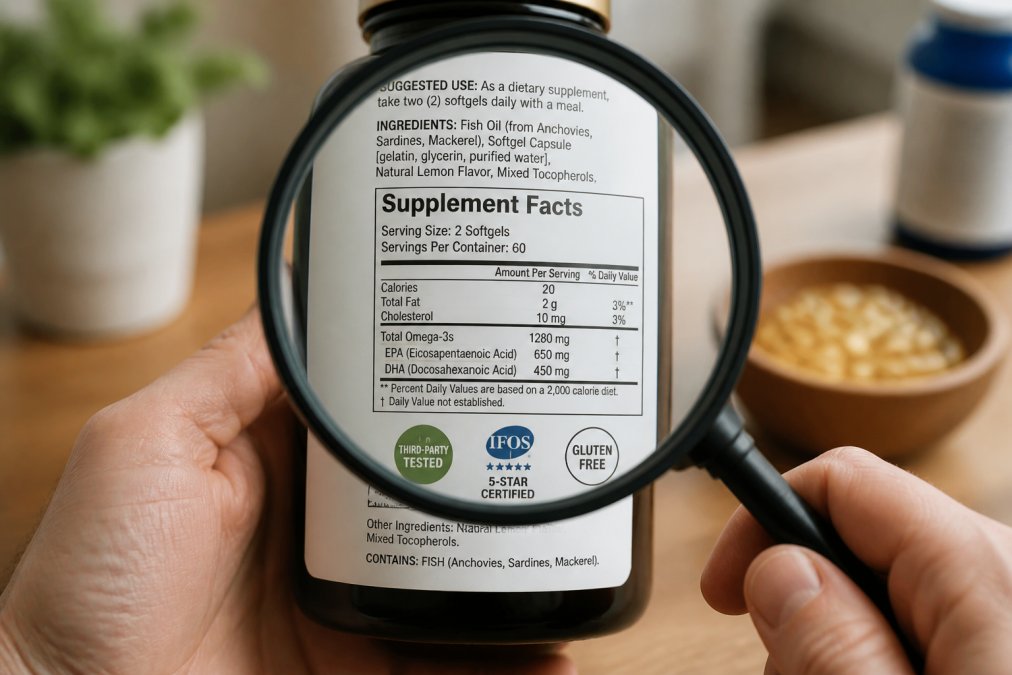
Serving Size and Capsule Count: Check how many capsules constitute one serving. Some products require three capsules to get the stated dose. More capsules means more cost per serving and reduced compliance.
EPA and DHA Content: The label should clearly state milligrams of EPA and milligrams of DHA per serving. Some labels list "total omega-3," which is misleading because that includes ALA from flax and other sources, which your body converts inefficiently. Focus on the EPA and DHA numbers specifically.
Fish Oil Source: The label should identify whether the oil comes from salmon, anchovy, sardine, or another species. Anchovy and sardine tend to be more sustainable because they're smaller, shorter-lived fish that don't accumulate as many toxins.
Form of Omega-3: Look for "triglyceride" or "natural triglyceride" on the label. If you see "ethyl ester" or no specification, the manufacturer may not be highlighting the form because it's less bioavailable.
Certification Marks: USP, NSF, or ConsumerLab marks should appear on the label or packaging. Their presence provides assurance.
Oxidation Testing Results: Reputable manufacturers include TOTOX values or peroxide values on the label or make them available on their website. If you can't find this information, ask the manufacturer directly.
Other Ingredients: Check for unnecessary additives. Fish oil supplements need minimal ingredients: the oil itself, a capsule, and perhaps vitamin E as a natural preservative.
Fish Oil and Medication Interactions: What You Need to Know
Fish oil's blood-thinning properties create important interactions with certain medications. High-dose fish oil supplements (above 3,000 mg daily of combined EPA and DHA) can increase bleeding risk when combined with anticoagulant medications like warfarin or antiplatelet drugs like aspirin or clopidogrel. This doesn't mean you can't take both, but your healthcare provider needs to know so they can monitor clotting times and adjust medication dosages if necessary.
Fish oil may also interact with certain blood pressure medications, potentially enhancing their effect. If you're taking antihypertensive drugs and adding fish oil supplementation, your blood pressure may drop further than expected. Some medications reduce fat absorption, which would impair fish oil effectiveness. Orlistat, used for weight loss, falls into this category.
Before starting high-dose fish oil supplementation, inform your doctor or pharmacist, particularly if you're on blood thinners, blood pressure medications, or medications affecting fat absorption. Most interactions are manageable with awareness and monitoring.
Choosing high quality fish oil requires understanding the forms available, verifying purity through third-party testing, and matching dosage to your individual inflammatory response. When you invest time in selecting a genuinely effective fish oil, one with verified purity, appropriate bioavailability, and sustainable sourcing, you're investing in a foundation for better outcomes. Start with a quality triglyceride form from a manufacturer that provides purity documentation, observe your response over 4-6 weeks, and adjust dosage based on your results. Request an appointment at Alternative Health & Healing Center to discuss how fish oil supplementation fits into your personalized pain management and wellness strategy.
=== FAQ ANSWERS (audit these too, same rules) ===
[1] Q: What's the difference between triglyceride and ethyl ester fish oil? A: Triglyceride fish oil is the natural form found in fish, with better absorption rates in your body. Ethyl ester is chemically processed and less bioavailable, meaning your body absorbs less of the beneficial omega-3 fatty acids. If bioavailability matters to you, triglyceride forms deliver more eicosapentaenoic acid (EPA) and docosahexaenoic acid (DHA) per dose. Check your label to see which form you're getting.
[2] Q: How much omega-3 dosage for inflammation should I take daily? A: General recommendations for omega-3 dosage for inflammation range from 1,000 to 3,000 mg of combined EPA and DHA daily, though some people with inflammatory conditions take higher amounts. Your optimal dose depends on your specific health situation, current medications, and inflammation markers. Consult a healthcare provider to determine the right omega-3 dosage for your needs before starting supplementation.
[3] Q: How can I tell if fish oil is rancid or oxidized? A: Rancid fish oil has a strong fishy smell, tastes unpleasant, or appears discolored. Check the TOTOX value (total oxidation) on the label, lower is better. Look for the manufacturing and expiration dates; older supplements are more likely oxidized. Store your fish oil in a cool, dark place and refrigerate after opening. If it smells off or tastes unusually strong, discard it.
[4] Q: What fish oil purity testing standards should I look for on the label? A: Look for third-party testing from organizations that verify heavy metal testing, PCB levels, and oxidation markers. Certifications from NSF International, USP, or ConsumerLab indicate independent verification of purity. The label should show that the product has been tested for mercury content and polychlorinated biphenyls (PCBs). These standards ensure your supplement is free from harmful contaminants.
Frequently Asked Questions
What's the difference between triglyceride and ethyl ester fish oil?
Triglyceride fish oil is the natural form found in fish, with better absorption rates in your body. Ethyl ester is chemically processed and less bioavailable, meaning your body absorbs less of the beneficial omega-3 fatty acids. If bioavailability matters to you, triglyceride forms deliver more eicosapentaenoic acid (EPA) and docosahexaenoic acid (DHA) per dose. Check your label to see which form you're getting.
How much omega-3 dosage for inflammation should I take daily?
General recommendations for omega-3 dosage for inflammation range from 1,000 to 3,000 mg of combined EPA and DHA daily, though some people with inflammatory conditions take higher amounts. Your optimal dose depends on your specific health situation, current medications, and inflammation markers. Consult a healthcare provider to determine the right omega-3 dosage for your needs before starting supplementation.
How can I tell if fish oil is rancid or oxidized?
Rancid fish oil has a strong fishy smell, tastes unpleasant, or appears discolored. Check the TOTOX value (total oxidation) on the label, lower is better. Look for the manufacturing and expiration dates; older supplements are more likely oxidized. Store your fish oil in a cool, dark place and refrigerate after opening. If it smells off or tastes unusually strong, discard it.
What fish oil purity testing standards should I look for on the label?
Look for third-party testing from organizations that verify heavy metal testing, PCB levels, and oxidation markers. Certifications from NSF International, USP, or ConsumerLab indicate independent verification of purity. The label should show that the product has been tested for mercury content and polychlorinated biphenyls (PCBs). These standards ensure your supplement is free from harmful contaminants.


