how-to
Improve Body Biomechanics Naturally: A How-To Guide
Table of Contents
- Assess Your Current Biomechanics: A Self-Evaluation Framework
- How to Improve Body Mechanics Through Posture and Alignment
- Mobility Exercises for Better Movement and Joint Health
- Natural Ways to Improve Flexibility and Range of Motion
- Warm-Up and Light Cardio: Foundation for Healthy Movement
- Holistic Approaches to Pain Relief and Tissue Recovery
- When to Seek Professional Assessment and Support
- Build Your Daily Biomechanics Routine
- Frequently Asked Questions
Last Updated: October 11, 2026
Assess Your Current Biomechanics: A Self-Evaluation Framework
Before you improve body biomechanics, you need to know where you stand. A simple self-assessment takes 10 minutes and reveals the movement patterns that need attention. (Source: range of motion exercises and therapy)
Start by standing in front of a mirror. Look at your posture from the side. Your ears should sit over your shoulders. Your shoulders should sit over your hips.
Next, check your movement patterns. Walk normally for 20 steps. Do your feet point straight ahead or turn inward? Do your knees track over your toes or cave inward?
Test your flexibility and range of motion. Touch your toes without bending your knees. Can you reach your ankles, shins, or knees? Reach one arm over your shoulder and one up your back.
Finally, notice where you feel stiffness or tension during the day. Do your hips feel tight after sitting? Does your neck ache by evening? Does your lower back protest when you bend? These pain signals point directly to the biomechanical issues that need correction.
How to Improve Body Mechanics Through Posture and Alignment
Good posture is the foundation of healthy body mechanics. It means your joints align properly, muscles work efficiently, and your spine stays protected. Poor posture forces muscles to work harder and joints to bear uneven loads. Over time, this leads to pain and injury.
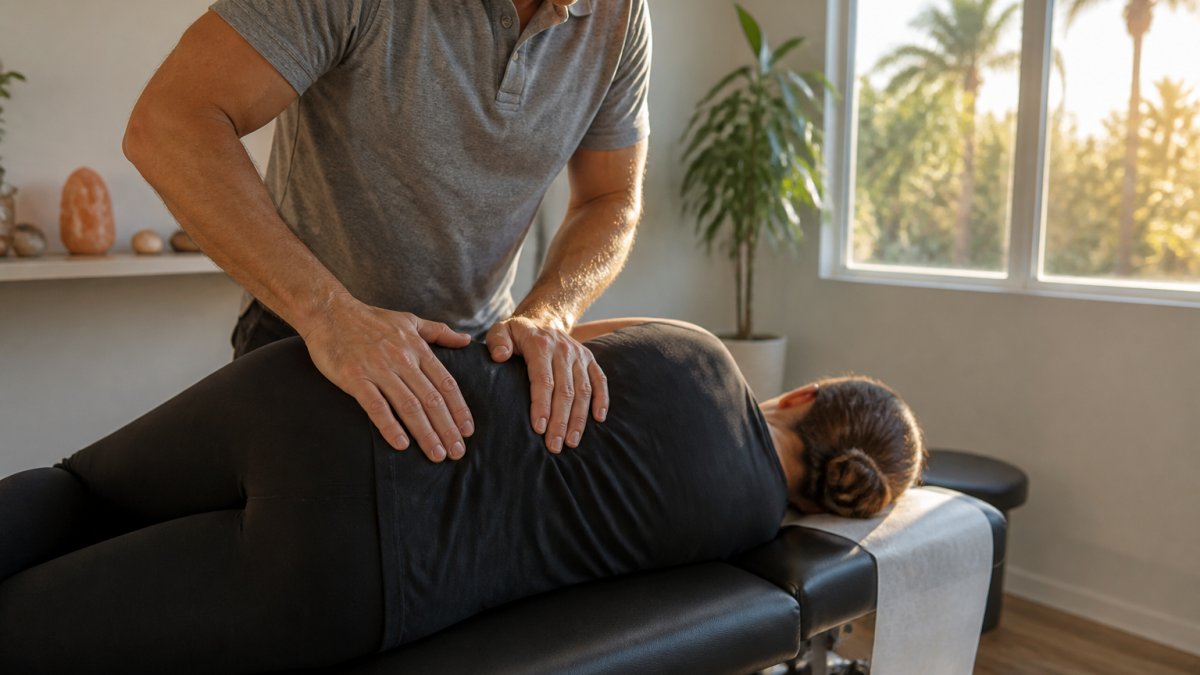
The key is neutral spine alignment. Your spine has natural curves. Your neck curves inward. Your upper back curves outward. Your lower back curves inward. Good posture maintains these curves instead of flattening or exaggerating them.
Here's how to find neutral spine while standing:
- Stand with feet hip-width apart
- Let your arms hang naturally at your sides
- Imagine a plumb line from your ear through your shoulder to your hip to your ankle
- Tuck your chin slightly so your gaze points forward, not down
- Relax your shoulders away from your ears
- Engage your core lightly without holding your breath
Once you feel neutral spine standing, practice it sitting. Adjust your chair so your hips are slightly higher than your knees. Keep your feet flat on the floor. Position your screen at eye level. Your forearms should rest at 90 degrees.
At Alternative Health & Healing Center, we help patients understand that posture isn't about standing rigidly. It's about teaching your body to work efficiently. When your joints align properly, muscles engage correctly, and pain often decreases without any other intervention.
Mobility Exercises for Better Movement and Joint Health
Mobility is different from flexibility. Flexibility means your muscles can lengthen. Mobility means your joints can move through their full range with control. You need both.
Start with shoulder mobility. Tight shoulders limit arm movement and force your neck to compensate. Do this daily:
- Arm circles forward: 10 slow circles, then 10 backward
- Shoulder rolls: 10 forward, 10 backward
- Doorway chest stretch: stand in a doorway with your arm bent 90 degrees on the frame, step forward gently until you feel a stretch across your chest, hold 30 seconds each side
- Cross-body shoulder stretch: pull one arm across your chest with the other arm, hold 30 seconds each side
Hip mobility opens up your entire lower body. Tight hips force your lower back to move more, which causes pain.
Try these hip exercises:
- 90-90 stretch: sit with one leg in front of you bent at 90 degrees, one leg to the side bent at 90 degrees, lean forward gently, hold 30-45 seconds each side
- Pigeon pose: kneel, bring one foot forward in front of you, keep your back leg extended, lean forward, hold 30-45 seconds each side
- Cossack squats: stand with feet wide, shift your weight side to side, keeping one leg straight and bending the other, 10 reps each direction
- Glute bridges: lie on your back with knees bent, push through your heels to lift your hips, squeeze your glutes at the top, 15-20 reps
Neck mobility prevents stiffness and headaches. Spend just 3 minutes on these movements:
- Neck rotations: slowly turn your head to look over each shoulder, hold 10 seconds each side, 5 reps
- Neck tilts: slowly tilt your ear toward each shoulder, hold 10 seconds each side, 5 reps
- Gentle neck flexion: slowly lower your chin toward your chest, hold 10 seconds, 5 reps
Natural Ways to Improve Flexibility and Range of Motion
Flexibility training lengthens muscles and improves range of motion. Unlike mobility work, which focuses on joints, flexibility targets the soft tissue itself.
Static stretching works best after exercise when muscles are warm. Hold each stretch for 30-60 seconds. Breathe slowly. Never bounce or force the stretch.
Essential stretches for daily flexibility:
- Hamstring stretch: sit with legs extended, fold forward gently, hold 45 seconds
- Quad stretch: stand on one leg, pull your other foot toward your glutes, hold 45 seconds each side
- Calf stretch: step one foot forward in a lunge, keep your back heel down, hold 45 seconds each side
- Spinal twist: lie on your back, pull one knee toward your opposite shoulder, hold 45 seconds each side
- Child's pose: kneel, sit your hips back toward your heels, extend your arms forward, hold 60 seconds
Yoga naturally improves flexibility while building body awareness. Poses like downward dog, warrior flows, and forward folds lengthen muscles and teach your body better movement patterns.
Dynamic stretching before activity prepares muscles for work. Walk with high knees. Do walking lunges. Swing your legs gently. These movements warm tissue and improve range of motion when you need it most.
| Stretch Type | Best Timing | Duration | Frequency |
|---|---|---|---|
| Static stretching | After exercise | 30-60 seconds per stretch | Daily |
| Dynamic stretching | Before exercise | 5-10 minutes total | Before activity |
| Yoga | Any time | 15-30 minutes | 3+ times per week |
| Foam rolling | After exercise | 1-2 minutes per area | 3-4 times per week |
Warm-Up and Light Cardio: Foundation for Healthy Movement
Warming up prepares your body for movement. Cold muscles are stiff, tight, and injury-prone. A proper warm-up increases blood flow, raises body temperature, and activates stabilizing muscles.
Spend 5-10 minutes on light cardio before any exercise:
- Easy walking: 2-3 minutes at conversational pace
- Arm circles and leg swings: 1 minute
- Marching in place with high knees: 1 minute
- Gentle torso rotations: 1 minute
- Walking lunges: 1 minute (Source: National Institute of Arthritis and Musculoskeletal and Skin Diseases (NIAMS))
This warm-up costs almost nothing but prevents injury and improves performance dramatically.
Light cardio also improves body mechanics over time. Walking is the most accessible form. It strengthens your core, improves balance, and teaches proper movement patterns.
Swimming and cycling are excellent low-impact options. They build cardiovascular fitness without the joint stress of running. Water supports your body weight, making swimming ideal for people with joint pain or arthritis.
Consistency matters more than intensity. Three 20-minute walks per week beats one intense session. Your body adapts to regular movement and becomes more resilient.
Holistic Approaches to Pain Relief and Tissue Recovery
Pain is your body's signal that something needs attention. Rather than masking it, address the underlying cause.
Soft tissue work releases muscle tension and improves circulation. Massage targets knots and trigger points that restrict movement. Deep tissue massage addresses chronic tension.
Use a foam roller 1-2 minutes per muscle group, 3-4 times per week:
- Calves: roll slowly from ankle to knee
- Quadriceps: roll from knee to hip
- IT band: lie on your side, roll from hip to knee
- Upper back: roll from mid-back to shoulders
- Lower back: avoid rolling directly on the spine; roll the muscles beside it
Heat and cold both help. Heat increases blood flow and relaxes tight muscles. Use heat for chronic stiffness.
Hydration supports tissue repair. Muscles are 75% water. Dehydration stiffens tissue and slows healing. Drink consistently throughout the day, not just when thirsty.
Nutrition matters too. Protein rebuilds damaged tissue. Vitamin C supports collagen formation. Omega-3 fatty acids reduce inflammation. Magnesium helps muscles relax.
Sleep is when your body repairs itself. Poor sleep slows recovery and increases pain perception. Aim for 7-9 hours nightly.
When to Seek Professional Assessment and Support
Some biomechanical problems need professional help. Know when to seek it.
See a healthcare provider if:
- Pain persists despite weeks of self-care
- Pain limits your daily activities or sleep
- You have numbness, tingling, or weakness
- You've had a recent injury or surgery
- Pain comes with swelling, redness, or warmth
- You can't identify the cause of your pain
A thorough assessment reveals the root cause. At Alternative Health & Healing Center, we use Applied Kinesiology and advanced diagnostic methods to understand your specific movement patterns and biomechanical issues. This personalized approach identifies exactly what needs correction, whether that's posture, mobility, muscle imbalance, or joint alignment.
Professional treatment accelerates recovery. Therapeutic techniques like massage, spinal decompression, and acoustic wave therapy can address deep tissue problems that self-care alone may not fully reach. Combined with your home routine, professional support produces faster, more lasting results.
Build Your Daily Biomechanics Routine
A sustainable routine requires just 15-20 minutes daily. Consistency matters more than perfection.
Morning routine (5 minutes):
- Standing posture check: 1 minute
- Gentle neck mobility: 2 minutes
- Shoulder circles and stretches: 2 minutes
Midday movement (5 minutes):
- Walk for 5 minutes at conversational pace
Evening routine (10 minutes):
- Hip mobility exercises: 5 minutes
- Static stretching: 5 minutes
3 times per week (15-20 minutes):
- Warm-up: 5 minutes
- Yoga or light cardio: 15 minutes
This simple structure addresses posture, mobility, flexibility, and cardiovascular fitness. Track your progress. Notice when movement feels easier. Watch your posture improve in the mirror. Feel pain decrease over weeks.
| Time | Activity | Duration | Frequency |
|---|---|---|---|
| Morning | Posture check + neck + shoulders | 5 minutes | Daily |
| Midday | Easy walk | 5 minutes | Daily |
| Evening | Hip mobility + stretching | 10 minutes | Daily |
| Dedicated session | Yoga or cardio | 15-20 minutes | 3x weekly |
Most people see noticeable improvements in body mechanics within 4-6 weeks of consistent practice. Pain may decrease. Movement can become easier. Posture may improve naturally as muscles rebalance.
The key is starting small and building gradually. Don't try to do everything at once. Pick three exercises that address your biggest issues. Do them daily for two weeks.
Improving your body biomechanics naturally takes time, but the results are worth it. Better posture, improved mobility, and reduced pain come from consistent, intelligent movement.
Frequently Asked Questions
How can I improve my body's biomechanics naturally?
Start with a self-assessment of your posture, mobility, and movement patterns. Incorporate daily warm-ups, mobility exercises targeting hips and shoulders, and corrective stretching. Focus on alignment during everyday tasks like sitting and walking. Add mindful movement practices like yoga. Progress gradually over 4-6 weeks, tracking improvements in range of motion and pain levels. Consistency matters more than intensity.
What exercises can help improve body mechanics?
Effective exercises include hip mobility drills, shoulder rolls and scapular work, spinal rotation stretches, and balance-training movements. Light cardio like walking activates proper muscle function. Corrective exercises targeting weak or tight areas restore alignment. Yoga and tai chi build coordination and body awareness. Start with 5-10 minutes daily, focusing on quality movement over speed or intensity.
How long does it take to see results from improving body mechanics naturally?
Many people notice reduced stiffness and improved range of motion within 2-3 weeks of consistent practice. Pain relief may develop over 4-8 weeks as muscle function restores and alignment improves. Significant biomechanical changes can take 8-12 weeks. Results depend on your starting point, consistency, and the severity of your condition. Working with a professional may accelerate progress.
When should I see a health care professional about movement problems?
Consult a qualified practitioner if pain worsens despite consistent self-care, if you cannot identify your movement limitations, if you have a history of surgery or trauma, or if you suspect nerve involvement. Conditions like fibromyalgia, arthritis, or complex systemic issues benefit from professional assessment. A practitioner trained in biomechanics and corrective exercise can create a personalized plan tailored to your specific needs.