how-to
Simple Desk Exercises to Improve Spinal Alignment
Table of Contents
- Why Spinal Alignment Matters for Desk Workers
- Setting Up Your Ergonomic Desk Setup for Neutral Spine
- Essential Posture Exercises at Desk You Can Do Now
- Desk Stretches for Back Pain Relief
- Movement Breaks for Desk Workers: Dosage and Frequency
- Your Complete Workday Movement Plan
- When to Seek Professional Care
- Frequently Asked Questions
Last Updated: October 12, 2026
Why Spinal Alignment Matters for Desk Workers
Sitting at a desk for eight hours a day takes a toll on your spine.
Slouching feels comfortable in the moment, but over time it compresses your spine and weakens supporting muscles, and pain follows.
Neutral spine is the natural S-curve of your backbone when standing upright: head over shoulders, shoulders over hips.
The good news: you don't need expensive equipment or hours at a gym. Simple desk exercises to improve spinal alignment, done consistently, take minutes and require only your desk chair.
Setting Up Your Ergonomic Desk Setup for Neutral Spine
Before you start exercising, fix your workspace. A bad desk setup undermines everything you do.
Position your chair correctly:
- Feet flat on the floor
- Knees bent at 90 degrees
- Hips level with or slightly higher than knees
Adjust your desk height:
- Elbows bent at 90 degrees when your hands rest on the keyboard
- Screen at eye level, about 20 inches away
- Wrists straight, not bent upward or downward
Check your monitor position:
- Top of screen at or slightly below eye level
- Directly in front of you, not off to the side
- Far enough away that you don't lean forward to read
When your workspace supports neutral spine, your postural muscles work less hard, meaning less fatigue and fewer aches by day's end.
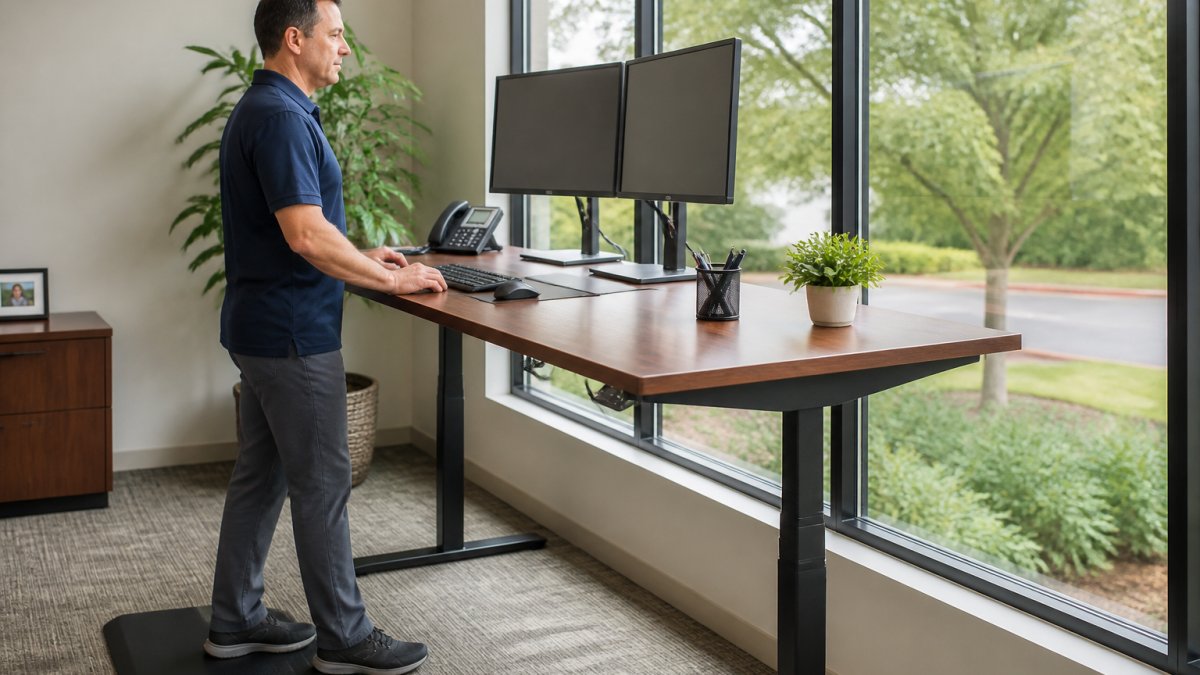
Essential Posture Exercises at Desk You Can Do Now
These exercises target the muscles that support spinal alignment. Do them throughout your workday, not just once.
Shoulder Rolls and Blade Squeezes
Shoulder tension pulls your spine out of alignment. Rolling your shoulders releases it and engages your upper-back muscles.
How to do shoulder rolls:
- Sit upright with feet flat on the floor
- Lift both shoulders toward your ears
- Roll them backward in a smooth circle
- Complete 10 rolls backward
- Reverse direction and do 10 rolls forward
How to do shoulder-blade squeezes:
- Sit upright with good posture
- Squeeze your shoulder blades together as if pinching a pencil between them
- Hold for 3 seconds
- Release and relax
- Repeat 15 times
Shoulder-blade squeezes strengthen the muscles between your ribs and spine, crucial for maintaining neutral spine all day.
Seated Spinal Twist for Trunk Rotation
A seated spinal twist restores mobility to your thoracic spine, the mid-back region that locks up from sitting.
How to do a seated spinal twist:
- Sit upright in your chair with feet flat
- Cross your right arm over your chest and place your left hand on your right knee
- Gently rotate your torso to the left
- Hold for 20-30 seconds
- Return to center
- Repeat on the opposite side
This movement increases spinal mobility and reduces back-muscle tension. Do it every hour for best results.
Neck Nods and Gentle Head Movements
Your neck supports your head, which weighs about 10 pounds. Poor posture adds extra strain. Gentle neck movements restore alignment and ease tension.
How to do neck nods:
- Sit upright with shoulders relaxed
- Slowly nod your head forward and backward
- Do 10 nods in each direction
- Move slowly and smoothly, no jerking
How to do gentle neck rolls:
- Drop your right ear toward your right shoulder
- Slowly roll your chin toward your chest
- Continue rolling until your left ear moves toward your left shoulder
- Reverse the direction
- Complete 5 rolls in each direction
Never roll your head backward. This position compresses the back of your neck and can cause discomfort.
Chest Stretch and Spine Extension
Sitting rounds your shoulders and chest. A chest stretch opens this area and lets your spine extend properly.
How to do a chest stretch at your desk:
- Sit upright in your chair
- Clasp your hands behind your head
- Gently pull your elbows back while pressing your chest forward
- Hold for 20-30 seconds
- Relax and repeat 3 times
This stretch counteracts the forward-rounded posture from typing and mouse work.
Desk Stretches for Back Pain Relief
Back pain often signals that your spine is out of alignment. These stretches target where tension builds.
Lower-Back Pain Relief Techniques
Your lower back bears your upper body's weight. When you slouch, those muscles work overtime to hold you up.
Cat-cow movement (seated version):
- Sit upright with hands on your thighs
- Arch your lower back and lift your chest (the "cow" position)
- Hold for 2 seconds
- Round your lower back and drop your chest (the "cat" position)
- Hold for 2 seconds
- Repeat 10 times slowly
This movement flexes and extends your spine, releasing lower-back tension.
Seated knee to chest:
- Sit upright in your chair
- Lift your right knee toward your chest
- Use your hands to gently pull your knee closer
- Hold for 20-30 seconds
- Lower your foot and repeat on the left side
This stretch lengthens lower-back muscles and eases tension.
Upper-Back and Neck Tension Release
Upper-back and neck tension often comes from leaning forward at your desk. These stretches open the area and restore mobility.
Doorway chest stretch:
- Stand in a doorway
- Place your right forearm on the door frame at shoulder height
- Step forward until you feel a stretch across your chest and upper back
- Hold for 20-30 seconds
- Repeat on the left side
Neck stretch with hand assistance:
- Sit upright in your chair
- Place your right hand on the left side of your head
- Gently pull your right ear toward your right shoulder
- Hold for 20-30 seconds
- Repeat on the opposite side Maintaining this elongated neck position is significantly easier when you properly adjust lumbar support to stabilize your lower back and encourage a neutral spine.
Movement Breaks for Desk Workers: Dosage and Frequency
Most desk-exercise articles say "take breaks" without specifying how long, how often, or how hard, which is why so many routines fail. Postural muscles respond to frequency and consistency more than intensity, so aim for short, repeatable bouts across the day rather than one long session.
How to Dose Each Type of Movement
Different movements need different dosing: mobility stretches can be held longer and done less often, while strengthening moves need more reps but shorter holds.
| Movement type | Hold or rep target | Sets | Frequency | Why |
|---|---|---|---|---|
| Mobility (twists, cat-cow, neck nods) | 20-30 second holds or 8-10 slow reps | 2 | Every 60-90 minutes | Restores range lost to static sitting |
| Static stretch (chest, neck side bend, knee to chest) | 20-30 second holds | 2-3 per side | 2-3 times daily | Lengthens shortened tissue without overloading |
| Strengthening (shoulder-blade squeezes, chin tucks) | 3-5 second holds, 10-15 reps | 2-3 | 1-2 times daily | Builds endurance in postural muscles |
| Breathing/reset (diaphragmatic breathing with tall spine) | 5-6 slow breaths | 1 | Every hour | Reduces accessory-muscle tension |
A common pattern: people stretch 30 minutes once a week, feel briefly better, then regress. Ten 90-second breaks spread across the day outperform that single session for postural endurance.
Beginner-to-Advanced Progression
Start where you are and progress only when the current dose feels easy for a full week.
Beginner (weeks 1-2)
- Shoulder rolls: 8 per direction, once per hour
- Shoulder-blade squeezes: 8 reps with a 3-second hold, once daily
- Seated spinal twist: 15-second hold per side, twice daily
Intermediate (weeks 3-6)
- Shoulder-blade squeezes: 12 reps with a 5-second hold, twice daily
- Seated spinal twist: 25-second hold per side, every 90 minutes
- Add seated cat-cow: 10 slow reps, twice daily
Advanced (week 7 and beyond)
- Shoulder-blade squeezes: 15 reps with a 5-second hold, 3 sets, twice daily
- Add resisted shoulder-blade squeezes using a light resistance band anchored to a desk leg
- Seated spinal twist: 30-second hold per side, every hour
Progress one variable at a time, reps, hold time, or frequency, not all three. If a movement causes more than mild, brief discomfort, drop back a level.
A Realistic Daily Schedule
You don't need to block out a workout. Attach movement to things you already do.
- Before your first coffee or email: 60 seconds of shoulder rolls and chin tucks
- Every time you refill water or use the restroom: 60-90 seconds of one mobility move
- Mid-morning and mid-afternoon: 3-5 minutes of the full sequence
What Progress Actually Looks Like
Expect changes in how you feel before how you look. Most people notice less end-of-day neck and upper-back tightness within one to two weeks of consistent practice. Visible posture change takes longer and depends on strength gains in postural muscles, not the stretches themselves.
Tracking Without Overthinking
A simple tally on a sticky note works: mark each completed break with a dot, then count them at week's end. Aim for at least 20 movement breaks across a five-day workweek before adding intensity. Consistency matters most.
Your Complete Workday Movement Plan
Build a routine you'll actually follow. The best exercise is the one you do consistently.
Morning routine (5 minutes):
- Shoulder rolls: 10 backward, 10 forward
- Shoulder-blade squeezes: 15 repetitions
- Chest stretch: 30 seconds, 3 repetitions
- Neck nods: 10 forward and backward
Hourly desk breaks (2 minutes):
- Stand and stretch
- Shoulder rolls: 10 in each direction
- Spinal twist: 20-30 seconds each side
- Neck stretch: 20-30 seconds each side
Afternoon stretch session (5 minutes):
- Seated spinal twist: 30 seconds each side
- Seated knee to chest: 30 seconds each leg
- Cat-cow movement: 10 repetitions
- Neck rolls: 5 in each direction
End-of-day routine (5 minutes):
- Full chest stretch: 30 seconds, 3 repetitions
- Lower-back stretch: 30 seconds, 2 repetitions
- Neck stretches: 30 seconds each direction
- Shoulder rolls: 10 in each direction
This routine takes 17 minutes total across your day. Most people see posture and pain improvement within two weeks of consistent practice.
When to Seek Professional Care
Desk exercises are low-risk for most people but not appropriate for every situation. Knowing the difference between normal exercise sensation and a warning sign helps you decide whether to continue, modify, or get evaluated.
Expected Sensations vs. Warning Signs
Usually normal during or after these exercises:
- A gentle stretch or pulling feeling in the muscle being lengthened
- Mild, diffuse soreness in the upper back or shoulders for 24-48 hours after a new routine
- A feeling of release or "loosening" after a stretch
Stop the exercise and reassess if you feel:
- Sharp, stabbing, or electric-shock sensations
- Pain that shoots down an arm or leg
- Numbness, tingling, or weakness in a hand, foot, or limb
When to Pause and Modify
Some situations call for adapting the routine rather than stopping it.
- Acute flare-up of known back or neck pain: Skip loaded strengthening and stick to gentle range-of-motion moves within a comfortable range. Resume strengthening once pain is stable for several days.
- Recent injury, surgery, or fracture: Get clearance from your treating clinician before starting any desk exercise routine.
- Pregnancy: Avoid deep twists and lying-down positions. Seated mobility and breathing work are generally well tolerated, but confirm with your prenatal provider.
When to Seek Evaluation
Contact a healthcare provider if any of the following apply:
- Pain that persists beyond two to four weeks despite consistent, appropriate exercise
- Pain that wakes you from sleep or prevents you from finding a comfortable position
- Neurological symptoms, numbness, tingling, weakness, or changes in bowel or bladder control
What a Professional Evaluation Typically Involves
A clinician assessing posture-related pain starts with a history: how long symptoms have been present, what makes them better or worse, and what your workday looks like.
Next steps may include hands-on treatment, a physical therapy referral for structured strengthening, or imaging if a structural cause is suspected. Most posture-related complaints don't require imaging.
How to Talk to Your Provider
Bring specifics: which exercises you tried, how often, and what happened. Describe the location, quality, and timing of symptoms, for example, "aching in the right upper back that starts two hours into desk work and eases with shoulder-blade squeezes." That detail helps a clinician separate muscular fatigue from something needing a different approach.
the American Chiropractic Association offers patient resources on when to seek care for spine-related symptoms.
Frequently Asked Questions
How often should I take movement breaks from my desk?
Move every 30 to 60 minutes throughout your workday. Stand, walk, or perform desk stretches for 2 to 3 minutes each time. This frequency helps prevent muscle tension, maintains spinal alignment, and reduces the cumulative effects of prolonged sitting. If you experience neck or back pain, start with 30-minute intervals and adjust based on your comfort level.
Can simple desk exercises really improve spinal alignment?
Yes, when done consistently. Desk exercises strengthen postural muscles, increase spinal mobility, and create awareness of neutral spine positioning. They address muscle imbalances caused by slouching and rounded shoulders. For lasting results, combine exercises with ergonomic setup adjustments and regular movement breaks. Results typically improve over 2 to 4 weeks of consistent practice.
What should I do if desk exercises increase my pain?
Stop the exercise immediately and return to neutral sitting posture. Pain during movement may signal an underlying condition requiring professional evaluation. Consult a healthcare provider, such as a chiropractor or physical therapist, before continuing. They can assess your spinal alignment, identify the source of pain, and recommend safe modifications tailored to your specific needs.
How do I know if my desk setup supports good spinal alignment?
Your feet should rest flat on the floor with knees bent at 90 degrees. Your elbows should be at desk height, allowing your arms to rest comfortably. Your monitor should be at eye level, about an arm's length away. Your lower back should have support to maintain its natural curve. If you experience neck, shoulder, or lower-back pain after adjusting your setup, consult a professional to fine-tune your ergonomic desk setup.