 ultimate-guide
Why Back Pain Keeps Coming Back: A Complete Guide
Table of Contents
- Why Recurring Back Pain Happens
- How Posture and Sedentary Lifestyle Perpetuate Pain
- How to Prevent Back Pain Flare-Ups
- Exercises for Recurring Lower Back Pain
- When to See a Doctor for Back Pain
- Breaking the Cycle: Non-Surgical Treatment and Long-Term Management
- Frequently Asked Questions
Last Updated: August 6, 2026
Why Recurring Back Pain Happens
Recurring back pain results from specific, identifiable patterns that most people never address. Pain returns because the underlying issue was never fully resolved. You might receive temporary relief through rest, medication, or adjustments, but without addressing the root cause, the problem resurfaces. The muscles, ligaments, or spinal structures that were injured remain weakened or misaligned, forcing your body to compensate by recruiting other muscles and joints, which eventually fatigue and create new pain points.
Many treatment approaches fall short because they focus on symptom relief rather than functional restoration. If your posture remains poor, your core remains weak, or your daily habits haven't changed, the injury cycle repeats.
Muscle and Ligament Strain Triggers
Muscle and ligament strain is one of the most common causes of recurring back pain. Repetitive stress injuries develop when you perform the same movements with poor form over extended periods. Lifting incorrectly, reaching awkwardly, or maintaining static positions create micro-tears in muscle fibers and ligament tissue. Accumulated damage weakens the tissue, and when you exceed what that weakened tissue can handle, pain flares up again.
A common mistake is assuming that because pain subsided, the tissue fully healed. Muscle and ligament healing takes time, often longer than pain resolution. If you return to the same activities before healing is complete, you re-injure tissue that's still vulnerable.
Spinal Alignment and Disc Issues
Your spine is a complex structure of vertebrae, discs, and supporting ligaments. When alignment is compromised, pressure distribution changes. Discs may bulge or herniate, pressing on nerves and causing radiating pain.
Herniated discs and bulging discs cause recurring back pain because the underlying structural problem persists. Spinal alignment problems develop gradually through poor posture, muscle imbalances, and repetitive stress. Once misaligned, your spine's biomechanics change, certain movements become restricted, others become hypermobile to compensate, and load distribution becomes uneven. This uneven loading accelerates disc degeneration and perpetuates pain cycles.
The critical insight is that spinal alignment isn't static. Your spine responds to how you move, sit, sleep, and carry yourself throughout the day. If those daily habits are poor, alignment degrades again, which is why recurring back pain is so common.
How Posture and Sedentary Lifestyle Perpetuate Pain
Your posture and daily movement patterns are the most powerful determinants of whether your back pain returns. These factors are entirely within your control.
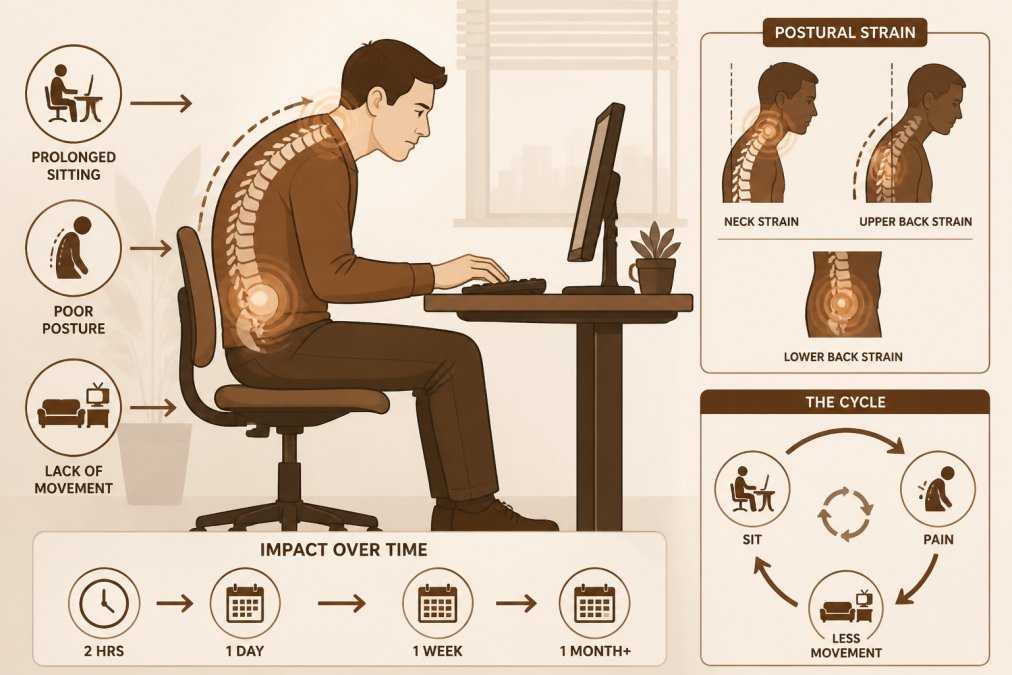
Prolonged sitting is devastating for your spine. When you sit, pressure on your lumbar discs increases significantly compared to standing or lying down. Your hip flexors tighten, your glutes weaken, and your core muscles disengage. Over hours, your postural muscles fatigue and you slump forward. This forward-rounded posture shifts weight distribution in your spine, compresses discs anteriorly, and activates pain pathways.
The sedentary lifestyle problem is compounded by what happens after sitting. Many people sit all day, then try to compensate with intense exercise. Your tissues aren't conditioned for this rhythm, leading to strain and injury.
Poor posture also activates your nervous system's stress response. When you're hunched forward, your chest is compressed, your breathing becomes shallow, and your parasympathetic nervous system becomes suppressed. Your body remains in a low-level stress state throughout the day, which amplifies pain perception and delays tissue healing.
Ergonomic assessment matters. If your monitor is too low, you'll crane your neck forward for eight hours. If your chair doesn't support your lumbar curve, your lower back will be unsupported. If your keyboard is too high, your shoulders will elevate and create tension. These daily sources of repetitive strain directly influence your pain levels.
How to Prevent Back Pain Flare-Ups
Preventing back pain flare-ups requires addressing the multiple factors contributing to your pain. Understanding your personal triggers is essential, as not all back pain has identical causes.
Core Stabilization and Functional Movement
Core stabilization is frequently misunderstood. It doesn't mean doing crunches until exhausted. It means training your deep abdominal muscles, back extensors, and pelvic floor to provide stable support for your spine during movement.
Your core includes your transverse abdominis, which wraps around your torso like a corset and provides deep stability, and your multifidus muscles, which run along your spine and control segmental stability. When these muscles function properly, they reduce demand on your spine's passive structures.
Functional movement means moving in ways that reflect how your body actually works. Instead of isolated exercises, functional training involves compound movements that integrate your core, lower body, and upper body. A deadlift teaches your body to lift with proper spinal alignment. A single-leg stance teaches your body to stabilize on one side.
Begin with foundational exercises: dead bugs, bird dogs, planks with proper form, and breathing drills. Progress to more challenging variations as your stability improves. The goal is to develop automatic, subconscious core engagement so your spine is protected during everyday activities.
Sleep Hygiene and Mattress Considerations
Sleep is when your body heals. During sleep, your nervous system shifts into parasympathetic dominance, inflammation decreases, and tissue repair accelerates. Poor sleep undermines all other recovery efforts.
Sleep quality depends partly on your sleep position and mattress. If you sleep on your stomach, your spine twists throughout the night. If you sleep on your back without pillow support under your knees, your lumbar spine arches excessively. If you sleep on your side without hip support, your pelvis rotates and creates asymmetrical loading.
The optimal sleep position is on your side with a pillow between your knees. This position keeps your spine neutral and prevents pelvic rotation. If you prefer back sleeping, place a pillow under your knees to reduce lumbar arch.
Your mattress should provide support without creating pressure points. A mattress that's too soft allows your spine to sag; one that's too firm creates concentrated pressure. The right mattress maintains spinal alignment while distributing pressure evenly.
Sleep hygiene extends beyond the mattress. Your bedroom temperature should be cool, around 65-68 degrees Fahrenheit. Your sleep schedule should be consistent. Screen time before bed should be minimized because blue light suppresses melatonin production. These factors collectively influence sleep quality, which directly impacts your pain levels.
Exercises for Recurring Lower Back Pain
Specific exercises can reduce pain and prevent flare-ups, but exercise selection matters. Generic back exercises might not address your particular issue.

Before beginning any exercise program, understand that exercise should not increase your pain. If an exercise causes sharp pain or radiating symptoms, stop immediately. Mild discomfort as muscles work is normal; pain is a warning signal.
Gentle spinal mobility exercises reduce stiffness. Cat-cow stretches mobilize your thoracic and lumbar spine. Child's pose stretches your lower back and hip flexors. These movements should be slow, controlled, and pain-free.
Core activation exercises build foundational stability. Transverse abdominis activation teaches your deep core to engage. Dead bugs develop core endurance. Glute activation is critical because weak glutes force your lower back to compensate during movement. Clamshells, glute bridges, and single-leg glute bridges activate your gluteus medius and maximus.
Hip flexor stretching addresses tightness from prolonged sitting. A low lunge stretch or 90-90 stretch releases tension in your iliopsoas. Tight hip flexors pull your pelvis forward and increase lumbar arch.
The progression should be: mobility work first, then activation exercises, then strengthening, then functional integration.
| Exercise | Purpose | Frequency |
|---|---|---|
| Cat-cow stretches | Spinal mobility and neural tension relief | Daily, 10 reps each direction |
| Dead bugs | Core endurance and lumbar stability | 3x/week, 10-15 reps per side |
| Glute bridges | Glute activation and hip extension strength | 3x/week, 15-20 reps |
| Bird dogs | Core stability with limb movement | 3x/week, 10 reps per side |
| Hip flexor stretches | Release hip tightness from sitting | Daily, 30-second holds |
When to See a Doctor for Back Pain
Most back pain resolves with conservative care. However, certain symptoms warrant professional evaluation.
Red Flag Symptoms and Emergency Signs
Seek immediate medical attention if you experience progressive neurological symptoms. Weakness that worsens over days, numbness that spreads, or loss of bowel or bladder control can indicate cauda equina syndrome, a serious condition requiring emergency surgery.
Unexplained weight loss combined with back pain can indicate underlying systemic disease. Fever with back pain suggests infection. Severe pain that doesn't improve with rest warrants imaging to rule out fracture or other structural damage.
If you've had cancer, osteoporosis, or prolonged corticosteroid use, back pain might indicate spinal metastasis or compression fracture. Seek professional evaluation if your pain follows a specific injury or trauma, or if pain persists beyond six weeks despite conservative care.
According to the American College of Radiology's guidelines on imaging for low back pain, imaging is most useful when combined with clinical examination findings.
Breaking the Cycle: Non-Surgical Treatment and Long-Term Management
Breaking the recurring back pain cycle requires addressing multiple factors simultaneously. Non-surgical treatment options include physical therapy, chiropractic care, and massage therapy. These approaches complement each other.
At Alternative Health & Healing Center, we combine these modalities with advanced technology like the Piezo Wave 2 to accelerate healing and reduce inflammation. Applied Kinesiology, a technique that uses muscle testing to identify functional imbalances, helps us pinpoint which specific structures need attention. This personalized approach, grounded in nearly 40 years of clinical experience, ensures you're receiving treatment targeted to your actual problem.
The key to long-term management is understanding that back pain prevention is ongoing. Small, sustainable changes, taking movement breaks every hour, maintaining postural awareness, performing core exercises three times weekly, sleeping in a supportive position, accumulate into significant improvements.
According to research from the National Institute of Neurological Disorders and Stroke on chronic pain management, multimodal treatment approaches addressing physical, behavioral, and psychological factors produce superior outcomes compared to single-modality treatment.
Nervous system regulation also matters. Chronic pain creates nervous system sensitization, decreasing your pain threshold and amplifying pain perception. Practices like deep breathing, meditation, and progressive muscle relaxation help regulate your nervous system and reduce pain amplification.
Post-rehabilitation maintenance is where most people fail. After completing physical therapy or chiropractic care, they stop exercising and return to old habits. Maintenance means continuing foundational exercises indefinitely, maintaining postural awareness, and addressing minor flare-ups before they become major problems.
The psychological component shouldn't be ignored. Fear of movement, catastrophizing about pain, and anxiety about re-injury all amplify pain perception. Cognitive behavioral approaches that challenge these thought patterns help reduce pain-related distress.
Long-term management also involves recognizing your personal pain triggers and respecting them. If you know that certain activities trigger flare-ups, you might perform extra core exercises beforehand, use proper body mechanics, and take frequent breaks.
According to the American Physical Therapy Association's guidelines for managing chronic low back pain, patient education and self-management are as important as direct treatment. Understanding your condition and taking responsibility for your own recovery produces better long-term outcomes than passive treatment alone.
Recurring back pain doesn't have to be your permanent reality. The cycle breaks when you address the underlying causes, muscle imbalances, postural dysfunction, movement pattern errors, and lifestyle factors, rather than just treating symptoms. Alternative Health & Healing Center specializes in identifying these root causes using Applied Kinesiology and advanced modalities like the Piezo Wave 2. Our nearly 40 years of clinical experience means we recognize patterns most practitioners miss. Request an appointment to develop a personalized recovery plan that addresses your specific situation and restores lasting function.
Frequently Asked Questions
Why does my back pain keep flaring up even after treatment?
Recurring back pain often returns because the underlying causes, poor posture, muscle imbalances, weak core stabilization, or lifestyle habits, haven't been fully addressed. Many people experience temporary relief but don't maintain the exercises, ergonomic changes, or movement patterns needed to prevent flare-ups. Chronic back pain requires ongoing management, not just a one-time treatment. A comprehensive approach that combines therapeutic care with home exercises and postural awareness gives you the best chance of breaking the cycle.
When should I be concerned about recurring back pain and see a doctor?
Seek medical attention if your recurring back pain is accompanied by numbness or tingling in your legs, loss of bladder or bowel control, severe weakness, unexplained weight loss, fever, or pain that wakes you at night. Also consult a professional if pain persists beyond six weeks, worsens despite self-care, or significantly limits your daily activities. A qualified healthcare provider can rule out serious conditions like herniated discs, nerve impingement, or degenerative disc disease and recommend appropriate treatment options tailored to your situation.
What exercises help prevent recurring lower back pain?
Core stabilization exercises are foundational for preventing back pain recurrence. These include planks, bridges, dead bugs, and bird dogs, movements that strengthen the muscles supporting your spine without excessive strain. Gentle stretching of hip flexors and hamstrings, combined with functional movement training, improves range of motion and reduces trigger points. Consistency matters more than intensity; performing these exercises 3-4 times weekly helps maintain muscle balance and spinal alignment. A physical therapist or movement specialist can show you proper form to avoid re-injury.
How does sleep and mattress quality affect recurring back pain?
Poor sleep hygiene and an unsupportive mattress contribute significantly to chronic back pain. Your spine needs proper alignment during sleep to allow muscles to recover and inflammation to decrease. A mattress that's too soft sags and misaligns your spine, while one that's too firm creates pressure points. Sleep position matters too, side sleeping with a pillow between your knees or back sleeping with support under your knees reduces lumbar strain. If you're waking with pain or your symptoms worsen after sleep, your mattress and sleep setup deserve evaluation as part of your long-term pain management strategy.


