 listicle
7 Yoga Poses for Reducing Chronic Inflammation
Table of Contents
- How Yoga Poses May Help With Chronic Inflammation
- Restorative Yoga for Inflammation: Creating a Sustainable Practice
- 7 Yoga Poses for Chronic Pain and Inflammation Relief
- Gentle Yoga Poses for Pain Relief: Safe Modifications and Contraindications
- Yoga for Stress Reduction and Nervous System Balance
- Yoga for Chronic Pain: Building Your Practice Plan
- How to Get Started and Measure Your Progress
- Frequently Asked Questions
Last Updated: October 16, 2026
How Yoga Poses May Help With Chronic Inflammation
Chronic inflammation drives many of the pain conditions we see at Alternative Health & Healing Center, the fire behind joint pain, fatigue, and stiffness. Yoga poses for reducing chronic inflammation work through gentle movement, deeper breathing, and nervous system regulation.
Gentle, deliberate movement increases circulation, activates the parasympathetic nervous system ("rest and digest"), and reduces stress hormones like cortisol; research shows regular gentle movement can shift the body away from a pro-inflammatory state.
This guide covers seven gentle yoga poses for inflammation relief, safe modifications, and how to build a sustainable practice.
Restorative Yoga for Inflammation: Creating a Sustainable Practice
Restorative yoga uses props, longer holds, and passive stretching to calm the nervous system and reduce inflammatory markers over time.
A sustainable practice means 10-15 minutes several times per week, not occasional intense sessions. The nervous system responds to regularity: repeat the same gentle sequence on a predictable schedule and your body learns to relax more easily.
Start with two or three poses held 3-5 minutes each and build gradually, the goal is a nourishing habit, not another obligation.
7 Yoga Poses for Chronic Pain and Inflammation Relief
These seven poses target where chronic inflammation commonly settles, the spine, hips, chest, and nervous system, improving circulation and signaling safety.
1. Child's Pose (Balasana)
Child's Pose calms the nervous system and stretches the hips and lower back.
How to practice:
- Start on your hands and knees on a yoga mat or padded surface
- Bring your big toes together and separate your knees wide (about hip-width or slightly wider)
- Sink your hips back toward your heels and rest your forehead on the mat or a block
- Let your arms extend forward or rest alongside your body
- Breathe deeply for 3-5 minutes
Why it helps: The forward fold lengthens the spine and reduces lower-back tension, a common inflammation hotspot, while the inward focus activates the parasympathetic response.
Modification: If your knees hurt, place a rolled towel behind them. If your forehead doesn't reach the mat comfortably, rest it on a yoga block or cushion.
2. Cat-Cow Pose (Marjaryasana-Bitilasana)
This gentle flow mobilizes the entire spine and coordinates movement with breath.
How to practice:
- Start on your hands and knees, wrists under shoulders, knees under hips
- Inhale and drop your belly, lift your gaze and chest toward the ceiling (Cow)
- Exhale and round your spine, tuck your chin and draw your belly in (Cat)
- Move slowly with your breath, 5-10 rounds
Why it helps: Each vertebra gets gentle mobilization and improved circulation, and the breath coordination activates your parasympathetic nervous system.
Modification: If wrist pain occurs, place your hands on blocks or rest on your forearms instead of full hand position.
3. Downward-Facing Dog (Adho Mukha Svanasana)
Downward-Facing Dog is an inversion that increases upper-body circulation while stretching the hamstrings, calves, and shoulders.
How to practice:
- Start on hands and knees
- Press your palms flat, spread your fingers wide
- Tuck your toes and lift your hips high, creating an inverted V shape
- Press your chest toward your thighs and let your head hang
- Hold for 30 seconds to 2 minutes
Why it helps: The inversion improves blood flow and lymphatic drainage, and the chest expansion supports fuller breaths that activate the relaxation response.
Modification: If shoulder pain occurs, widen your hand placement. If hamstrings are tight, bend your knees generously. Hold for 15-30 seconds if full inversions feel intense.
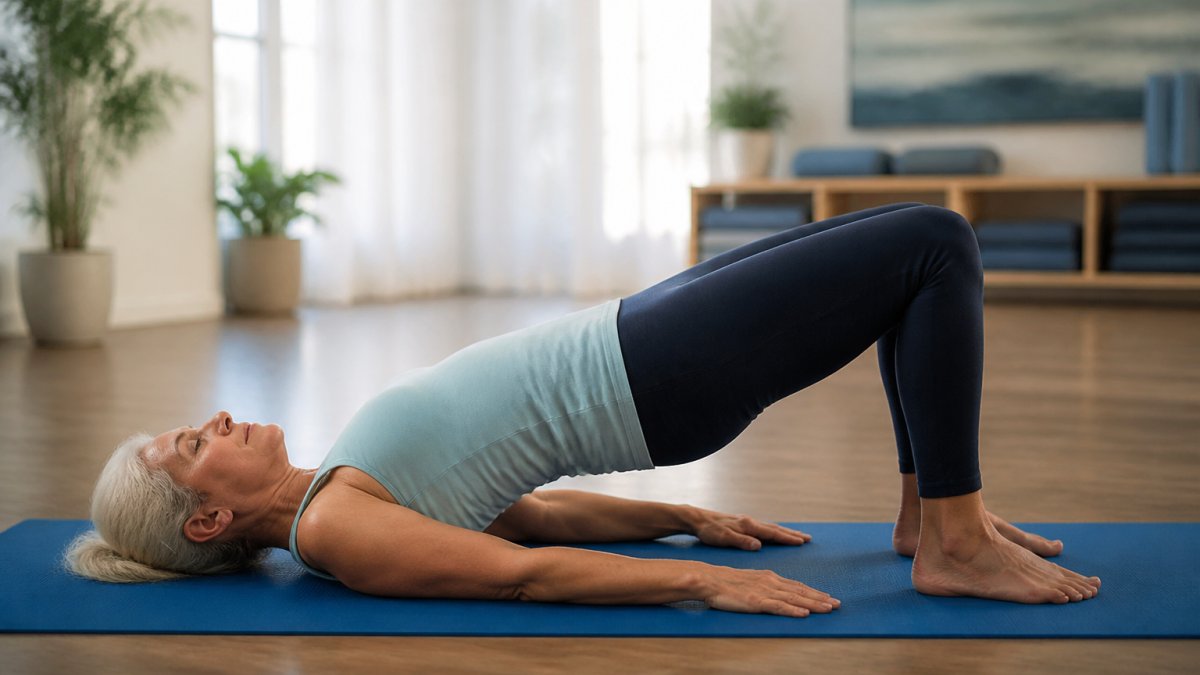
4. Bridge Pose (Setu Bandhasana)
Bridge Pose strengthens the posterior chain while gently stretching the chest, neck, spine, and hips.
How to practice:
- Lie on your back with knees bent, feet flat and parallel, hip-width apart
- Press your feet into the mat and lift your hips toward the ceiling
- Interlace your hands under your back and press your shoulders into the mat
- Keep your chest lifted and your gaze straight up
- Hold for 1-3 minutes
Why it helps: Bridge Pose opens the chest cavity for deeper breathing and activates the glutes and posterior chain, stabilizing the spine and reducing compensatory tension.
Modification: If neck strain occurs, keep your gaze neutral (don't turn your head). If you can't clasp your hands, simply rest your arms alongside your body.
5. Legs Up the Wall (Viparita Karani)
This restorative inversion is one of the most calming poses for the nervous system and requires no strength.
How to practice:
- Sit sideways against a wall with your right hip touching the wall
- Lie back and swing your legs up the wall, so your calves rest on the wall and your body forms an L shape
- Rest your arms alongside your body, palms up
- Stay here for 5-15 minutes, breathing naturally
Why it helps: Legs Up the Wall reverses blood flow, reduces leg swelling, and deeply activates the parasympathetic nervous system without the intensity of full inversions.
Modification: If your lower back feels strained, place a pillow under your hips to create a slight angle.
6. Warrior II (Virabhadrasana II)
Warrior II builds stability and maintains mobility and strength.
How to practice:
- Stand with your feet wide apart (about 3-4 feet)
- Turn your right foot out 90 degrees and angle your left foot slightly inward
- Bend your right knee until it stacks over your ankle
- Extend your arms to shoulder height, palms down
- Gaze over your right fingertips and hold for 30 seconds to 1 minute per side
Why it helps: Warrior II maintains lower-body strength and mobility, preventing the deconditioning that accompanies chronic pain.
Modification: If your knee pain increases, reduce the depth of the bend or shorten the hold time. You can also practice this pose with your hands on a chair for balance.
7. Cobra Pose (Bhujangasana)
Cobra Pose gently extends the spine and opens the chest, supporting fuller breaths and mobility.
How to practice:
- Lie on your belly with your hands under your shoulders
- Press your pubic bone and tops of your feet into the mat
- Inhale and press your hands into the mat, lifting your chest
- Keep your elbows close to your ribs and your shoulders relaxed away from your ears
- Hold for 15-30 seconds, breathing steadily Maintaining this gentle engagement of the core while grounding the pubic bone creates a stable foundation that naturally complements the integration of pelvic floor exercises to further soothe systemic tension.
Why it helps: The gentle backbend mobilizes the thoracic spine, opens the chest for deeper breathing, and engages the back body, which weakens when people guard against pain.
Modification: If full Cobra feels intense, practice Baby Cobra instead: keep your hands lightly on the mat and use your back muscles to lift rather than pressing strongly with your hands.
Gentle Yoga Poses for Pain Relief: Safe Modifications and Contraindications
Not every pose works for every body. Chronic pain often comes with limitations, arthritis, nerve sensitivity, previous surgery, or instability.
Common contraindications and how to modify:
If you have severe knee pain, avoid deep lunges and full Warrior II.
If you have neck pain or cervical spine issues, avoid full Downward Dog or Cobra Pose.
If you have hip replacement or severe hip arthritis, avoid deep hip openers like full pigeon or wide-legged forward folds.
If you have high blood pressure or glaucoma, avoid prolonged inversions like Legs Up the Wall or Downward Dog.
The principle is simple: if a pose increases pain, stop.
Yoga for Stress Reduction and Nervous System Balance
Stress and inflammatory response are deeply connected. When your nervous system perceives threat, it activates the sympathetic response, increased cortisol, elevated heart rate, and a pro-inflammatory state.
The poses here emphasize restorative and gentle styles because they calm rather than stimulate.
Even 5-10 minutes of breath awareness or body scan meditation after your poses deepens parasympathetic activation.
Stress reduction through yoga is measurable over weeks and months: resting heart rate may decrease, sleep may improve, and calm may deepen.
Yoga for Chronic Pain: Building Your Practice Plan
A sustainable yoga practice for chronic inflammation doesn't require hours per week. Consistency beats duration.
Beginner practice plan (start here):
- Frequency: 3-4 times per week
- Duration: 15-20 minutes
- Sequence: Child's Pose (5 min) → Cat-Cow (2 min) → Bridge Pose (2 min) → Legs Up the Wall (5 min)
Intermediate practice plan (after 4-6 weeks):
- Frequency: 4-5 times per week
- Duration: 20-30 minutes
- Sequence: Child's Pose (3 min) → Cat-Cow (2 min) → Downward Dog (1 min) → Bridge Pose (2 min) → Warrior II each side (1 min) → Legs Up the Wall (5 min)
Full practice plan (after 8-12 weeks):
- Frequency: 5-6 times per week
- Duration: 30-40 minutes
- Sequence: Include all seven poses, with holds adjusted to your capacity
Start small and add complexity slowly. Many people burn out by trying too much too soon; a 15-minute practice you actually do beats a 60-minute practice you skip.
How to Get Started and Measure Your Progress
Choose one or two poses from the list above, whichever feel most accessible, and practice for one week before adding more.
Track your progress not just by flexibility or strength, but by how you feel. Keep a simple log:
- Pain level before and after practice (on a 0-10 scale)
- Sleep quality the night after practice
- Energy level the next day
Most people notice shifts within 2-3 weeks: pain may decrease, movement may feel easier, and baseline stress may drop.
If you're managing complex conditions like fibromyalgia, autoimmune disease, or multiple chronic pain sites, work with a qualified yoga instructor or physical therapist alongside your healthcare provider to assess limitations and progress safely.
At Alternative Health & Healing Center, we combine gentle yoga with integrative therapies like chiropractic care and Applied Kinesiology.
Chronic inflammation often feels permanent, but your body can shift given the right conditions.
If you're working with chronic pain or inflammation and want personalized guidance on integrating yoga with professional care, consult with a qualified healthcare provider or reach out to Alternative Health & Healing Center to discuss how our integrative approach can support your healing journey.
Frequently Asked Questions
Can yoga help reduce chronic inflammation?
Yoga may help reduce chronic inflammation through movement, breathwork, and stress reduction. Gentle poses encourage circulation and mobility, while deep breathing helps calm the nervous system and reduce stress hormones like cortisol. Regular practice may support your body's natural inflammatory response. However, yoga should complement, not replace, medical care. Consult a healthcare professional before starting any new practice, especially if you have a diagnosed inflammatory condition.
What yoga poses are best for chronic pain?
Gentle and restorative poses tend to be most suitable for chronic pain. Child's Pose, Cat-Cow, Legs Up the Wall, and Bridge Pose are commonly recommended because they promote relaxation, improve circulation, and avoid high-impact stress on joints. Avoid deep backbends, intense twists, or poses that aggravate your specific pain. Always modify poses to match your body's needs, and work with a qualified yoga instructor or physical therapist who understands your condition.
How often should you practice yoga for inflammation support?
Most resources suggest practicing 3-5 times per week for noticeable benefits, though even gentle sessions 2-3 times weekly may help. Consistency matters more than intensity. Start with 15-20 minute sessions and gradually extend as your body adapts. Listen to your body and avoid overtraining, which can increase inflammation. A qualified yoga instructor or healthcare provider can help you design a schedule that fits your recovery needs and current pain levels.
What should you avoid when practicing yoga with chronic pain?
Avoid deep backbends, intense twists, high-impact flows, and poses that cause sharp pain or discomfort. Do not push into pain or try to match others' flexibility. Skip inversions if you have high blood pressure, neck issues, or eye conditions without professional guidance. Avoid hot yoga if heat aggravates your symptoms. Always warm up gently, use props like blocks and blankets, and modify every pose. If a pose feels wrong, stop immediately and consult a healthcare provider or certified yoga therapist.