 how-to
Chiropractic Care for Knee Arthritis Pain: Relief Guide
Table of Contents
- How Chiropractic Care for Knee Arthritis Pain Works
- Chiropractic Adjustments for Knee Pain: What to Expect
- Benefits of Piezo Wave Therapy for Joints
- Exercises for Knee Osteoarthritis Relief
- What to Expect During Your First Visit
- How to Find a Qualified Chiropractor for Knee Arthritis
- Frequently Asked Questions
Last Updated: September 14, 2026
How Chiropractic Care for Knee Arthritis Pain Works
Chiropractic care for knee arthritis pain is a non-surgical, hands-on approach that focuses on restoring proper joint mechanics, reducing inflammation, and improving the way the muscles and nerves around your knee communicate with your brain. At Alternative Health & Healing Center, we see this as treating the cause of the pain, not just the symptom.
The knee is a hinge joint, but it doesn't work in isolation. Your hips, ankles, and pelvis all influence how weight travels through your knee with every step. When one of those areas stops moving correctly, the knee often pays the price. A chiropractor evaluates the entire kinetic chain, looking for restrictions in the joints above and below the knee that could be contributing to the arthritic pain.
Knee arthritis is the gradual breakdown of cartilage that cushions the joint (the CDC). As that cushioning wears down, the joint can become stiff, swollen, and painful, especially after periods of rest or activity. Chiropractic treatment works to improve joint mobility, reduce muscle tension, and support the body's natural healing processes.
Arthritis Foundation overview of osteoarthritis explains that osteoarthritis is the most common form of arthritis and often affects the knees. For patients in their 50s and 60s, the combination of joint restriction and muscle weakness is usually what drives the pain cycle.
Chiropractic Adjustments for Knee Pain: What to Expect
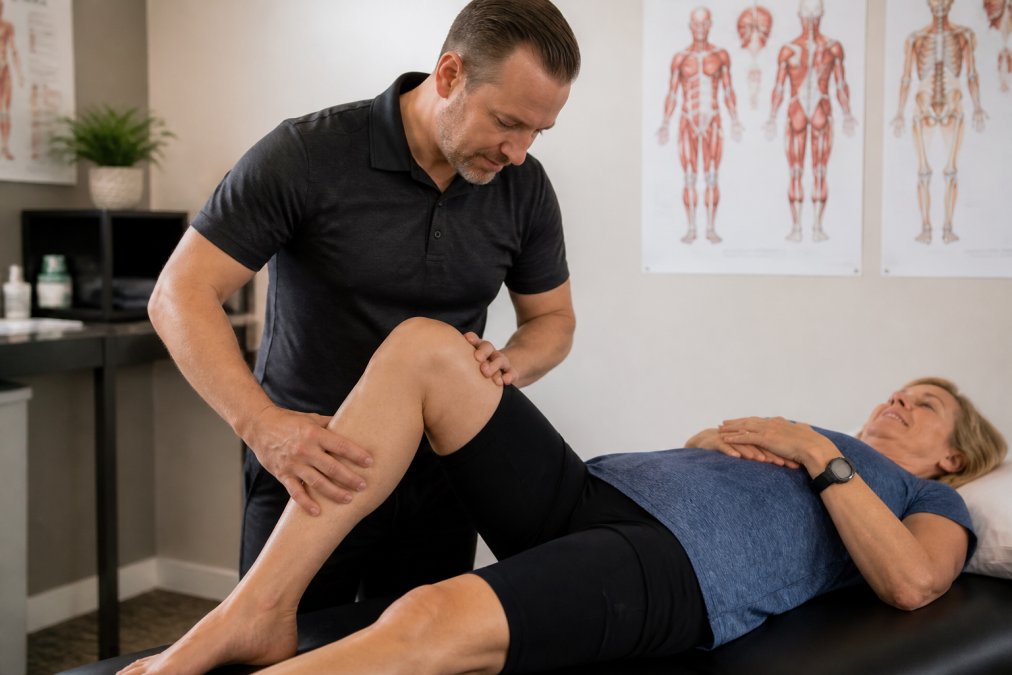
Chiropractic adjustments for knee pain are precise, controlled movements applied to the knee joint and surrounding structures to restore normal motion. Most patients describe the sensation as a gentle pressure followed by a release, not the forceful cracking they may have seen online.
During a session, the chiropractor may adjust the knee itself, the patella (kneecap), the ankle, and the hip. Restoring motion in the kneecap is often overlooked, but it matters because a patella that doesn't glide properly accelerates cartilage wear. Soft tissue work on the quadriceps, hamstrings, and calf muscles usually follows, since tight muscles pull the joint out of alignment.
Types of Adjustments Used for Knee Arthritis
Several techniques are commonly used for arthritic knees:
- Manual joint mobilization: Slow, graded movements that restore range of motion without a forceful thrust.
- Patellar mobilization: Specific glides applied to the kneecap to improve tracking.
- Flexion-distraction: A gentle traction technique that decompresses the joint.
- Instrument-assisted adjustments: A small handheld tool delivers targeted pressure to restricted areas.
- Soft tissue therapy: Hands-on work to release trigger points in the muscles supporting the knee.
A common mistake is assuming that one adjustment fixes everything. In practice, consistency matters more than intensity.
Benefits of Piezo Wave Therapy for Joints
Piezo Wave therapy uses acoustic wave energy to stimulate healing in damaged tissue around the joint. Unlike a traditional adjustment, which addresses alignment and motion, Piezo Wave therapy targets the soft tissue, tendons, and fascia that surround the arthritic knee.
The benefits of Piezo Wave therapy for joints include reduced pain, improved circulation to the treated area, and faster recovery from soft tissue injuries. It's especially useful for patients who have both arthritis and lingering myofascial pain, because the acoustic waves can break down scar tissue and adhesions that manual therapy alone can't reach.
At Alternative Health & Healing Center, Piezo Wave 2 technology is integrated into treatment plans for patients who need more than adjustments alone. A typical session takes 10 to 15 minutes, and most patients describe the sensation as a mild tapping or pulsing.
Exercises for Knee Osteoarthritis Relief
Exercises for knee osteoarthritis relief focus on strengthening the muscles that support the joint, improving flexibility, and reducing stiffness. The right exercises can make adjustments hold longer and reduce the frequency of flare-ups.
The most effective routine combines three elements: strengthening, stretching, and low-impact movement. Strengthening the quadriceps is particularly important, because weak quads allow the knee to shift inward during walking, which accelerates cartilage wear (pubmed.ncbi.nlm.nih.gov).
Low-Impact Exercises to Support Chiropractic Care
Try these exercises between visits:
- Straight leg raises: Lie on your back, tighten your thigh, and lift your leg 6 to 12 inches. Hold for 5 seconds. Do 10 to 15 reps per leg.
- Wall sits: Slide your back down a wall until your knees are bent to about 45 degrees. Hold for 15 to 30 seconds. Repeat 3 to 5 times.
- Heel slides: Lie on your back and slowly slide your heel toward your buttocks, bending the knee as far as comfortable. Return slowly. Do 10 reps per leg.
- Step-ups: Use a low step (4 to 6 inches). Step up with the affected leg, then step down. Do 10 reps.
- Stationary cycling: 10 to 15 minutes at low resistance, three to four times per week.
What to Expect During Your First Visit
Your first visit starts with a conversation, not a treatment. The chiropractor will ask about your pain history, what makes it worse, what you've already tried, and whether you've had imaging or a formal diagnosis.
A physical exam follows. Expect the chiropractor to check your knee range of motion, test the surrounding muscles, and evaluate how you walk and stand. They'll likely examine your hips and ankles too, since restrictions there often contribute to knee pain.
Treatment on the first visit is usually conservative. Treatment on the first visit is usually conservative. You'll leave with a clear idea of what the treatment plan looks like, how often you should come in, and what to do at home between visits.
How to Find a Qualified Chiropractor for Knee Arthritis
Look for a chiropractor who treats the whole body, not just the spot that hurts. For knee arthritis, that means someone who evaluates your gait, checks your hips and ankles, and uses a mix of manual therapy and corrective exercise, not just adjustments.
Ask about their experience with arthritis specifically. A chiropractor who mostly treats sports injuries may not have the same depth of experience with degenerative joint conditions. Ask whether they use adjunct therapies like acoustic wave or laser therapy, and whether they coordinate with your primary care doctor or orthopedic specialist.
Credentials matter. In the United States, chiropractors are licensed at the state level and must complete a Doctor of Chiropractic (DC) degree from an accredited program. You can verify a chiropractor's license through your state's licensing board.
At Alternative Health & Healing Center, our team brings nearly 40 years of clinical experience, with certifications in Acupuncture, Biofeedback, and NeuroCranial Restructuring. We specialize in Applied Kinesiology, which evaluates how muscles, joints, and organ systems interact, and we use advanced technology like the Piezo Wave 2 to support patients with chronic joint pain.
The best chiropractor for knee arthritis is one who treats the entire kinetic chain, uses multiple modalities, and gives you a home exercise plan. If a provider only adjusts the knee and sends you out the door, look elsewhere.
Frequently Asked Questions
Can a chiropractor help with knee arthritis?
Yes, chiropractic care can help manage knee arthritis pain. A chiropractor uses adjustments to improve joint alignment and reduce stress on the knee, along with therapies like Piezo Wave to ease inflammation. Many patients experience less pain and better mobility. However, results vary, and chiropractic care works best as part of a broader plan that may include exercise and lifestyle changes. Always consult a qualified professional to see if it's right for you.
What chiropractic techniques are used for knee pain?
Chiropractors may use manual adjustments to realign the knee joint, soft tissue therapy to release tight muscles, and modalities like Piezo Wave therapy to stimulate healing. They might also address misalignments in the hips or spine that affect knee mechanics. Your chiropractor will tailor the approach based on your specific condition and health history. Expect a thorough exam before any technique is applied.
Is chiropractic care safe for patients with osteoarthritis?
Chiropractic care is generally safe for osteoarthritis when performed by a licensed professional. Adjustments are modified to avoid further joint damage, and therapies like Piezo Wave are non-invasive. However, people with severe osteoporosis, spinal instability, or certain other conditions should avoid certain techniques. Always inform your chiropractor about your full health history and get clearance from your doctor if you have concerns.
How often should you see a chiropractor for knee arthritis?
The frequency of visits depends on your pain level, overall health, and how you respond to treatment. Your chiropractor will create a personalized schedule after evaluating your condition. Consistency is key, but the goal is to help you manage pain independently over time. Discuss any changes in symptoms at each visit.
Knee arthritis pain doesn't have to mean surgery or a lifetime of medication. A structured chiropractic plan that combines adjustments, Piezo Wave therapy, and targeted exercise can restore mobility and reduce pain for many patients. Alternative Health & Healing Center offers integrative chiropractic care built around Applied Kinesiology and nearly 40 years of clinical experience. Request an appointment to find out whether our approach fits your situation.


