 Listicle
Which Ergonomic Chair Works Best for Chronic Muscle Tension?
Last Updated: October 25, 2026
Quick Summary
An ergonomic chair chronic muscle tension works best when it supports your spine's natural curve, adjusts to fit your body, and reduces strain during long sitting sessions. The Herman Miller Aeron, Branch Ergonomic Chair Pro, and Anthros each excel for different needs, from full-time office workers to those with serious back pain.
- Lumbar support should adjust in both height and depth to match your lower back's natural inward curve.
- Seat depth should allow about a hand's width between the seat edge and the back of your knees to avoid circulation problems.
- Armrests must adjust up, down, and in and out to prevent shoulder tension from compensating for poor arm support.
- Stand and move every 60-90 minutes even in a perfect chair, as sitting 8+ hours daily creates tension regardless of seating.
- Professional evaluation is recommended if chronic muscle tension persists after optimizing your chair and workspace.
Table of Contents
- What Makes an Ergonomic Chair Effective for Chronic Muscle Tension
- Top Ergonomic Chairs for Chronic Muscle Tension: Comparison and Reviews
- Best Office Chair for Back Pain: Key Features to Prioritize
- Best Desk Chair for Neck Pain: Headrest and Upper-Body Support
- How to Adjust an Ergonomic Chair for Your Body and Desk
- The Limits of Chair Support: When Movement and Professional Care Matter
- Request a Consultation to Address Your Muscle Tension
- Frequently Asked Questions
What Makes an Ergonomic Chair Effective for Chronic Muscle Tension
An ergonomic chair for chronic muscle tension supports your spine's natural curve, reduces muscle pressure, and minimizes strain during long sitting sessions. What separates it from a standard office chair is adjustability, lumbar support, and weight-distributing materials.
Sit for hours without support and your neck, shoulders, and lower back compensate by tensing up until the tension becomes chronic. Understanding how chronic pain affects the body helps explain why proper chair support is so important for long-term relief.
Research shows that proper ergonomic support matters. According to the National Institute for Occupational Safety and Health, workplace ergonomics directly affects musculoskeletal health.
Top Ergonomic Chairs for Chronic Muscle Tension: Comparison and Reviews
Branch Ergonomic Chair Pro: Value and Comfort Balance
The Branch Ergonomic Chair Pro delivers solid support at a midrange price. Reviewers praise it for balancing comfort with affordability: adjustable lumbar support, a tilt mechanism, and height adjustment without premium pricing.
What works: The lumbar support adjusts vertically and depth-wise for your specific lower-back curve, and the seat is cushioned without compressing after a few months.
What doesn't: The armrests don't adjust as granularly as pricier models, and the backrest recline is limited.
Best for: Budget-conscious buyers who want real adjustability without premium pricing.
Skip if: You need highly adjustable armrests or extensive recline options.
Herman Miller Aeron: Premium Support for Extended Sitting
The Herman Miller Aeron is a workhorse and a standard in professional offices because it delivers on the ergonomic promise.
What works: The PostureFit lumbar support is genuinely effective, supporting your lower back without feeling rigid, and the mesh back breathes during long days.
What doesn't: The price is high. You're paying for durability and precision engineering, but if you're shopping on a tight budget, it's a significant investment.
Best for: Professionals spending full workdays sitting who need maximum adjustability and durability.
Skip if: Budget is your primary concern or you prefer a more cushioned feel.
Anthros: Designed for Serious Back Pain
Anthros targets people with serious back pain, focusing on spinal alignment through a unique backrest geometry rather than traditional ergonomic design.
What works: The backrest supports the natural S-curve of your spine.
What doesn't: Limited information is available on specific adjustment ranges or long-term durability. The specialized design means it's not a universal fit, some users report it works brilliantly for their pain, while others find it uncomfortable.
Best for: People with diagnosed back pain who need a chair specifically engineered for spinal support.
Skip if: You want broad adjustability or prefer a more traditional ergonomic design.
Haworth Fern: Flexible Backrest for Neck Relief
The Haworth Fern uses a digital knit backrest that feels pillowy and flexible, almost hammock-like, appealing to people whose chronic muscle tension centers on the neck and upper back.
What doesn't: Specific adjustment specs aren't widely available in standard reviews. The flexible backrest is a strength for comfort but means less targeted lumbar control than chairs with adjustable support systems.
Best for: People prioritizing neck and upper-back comfort who prefer a softer, more conforming backrest.
Skip if: You need precise lumbar support adjustment or a more budget-friendly option.
ROCTRY Ellis: Integrated Lumbar Massage Support
What works: The lumbar massage provides periodic muscle stimulation without leaving your desk, helping maintain comfort as tension tightens over the day.
What doesn't: The massage feature adds complexity, more moving parts mean more potential maintenance issues. Information on long-term durability of the airbag system is limited.
Best for: People seeking active muscle support during extended sitting and willing to invest in integrated technology.
Skip if: You prefer simpler designs or are skeptical of massage features as a primary solution.
| Chair | Key Feature | Best For | Adjustment Range |
|---|---|---|---|
| Branch Ergonomic Chair Pro | Adjustable lumbar support | Budget-conscious buyers | Height, tilt, lumbar depth |
| Herman Miller Aeron | Flexible PostureFit backrest | Full-time office workers | Height, tilt, armrests, recline |
| Anthros | Spinal-alignment geometry | Serious back pain | Specialized backrest design |
| Haworth Fern | Digital knit flexible backrest | Neck and shoulder relief | Flexible conforming support |
| ROCTRY Ellis | Lumbar airbag massage | Active muscle support | Height, tilt, massage intensity |
Best Office Chair for Back Pain: Key Features to Prioritize
Lumbar support is the foundation. Your lower back has a natural inward curve called lordosis, and a chair that flattens or ignores it forces your muscles to work harder.
Seat depth matters more than people realize. Too deep and the edge presses into your thighs, cutting circulation; too shallow and you slide forward and lose support.
Backrest recline should be smooth and controlled. A chair that locks you upright forces tension. One that reclines too easily lets you slouch. The best chairs let you tilt back slightly for breaks while maintaining support when you're working.
Best Desk Chair for Neck Pain: Headrest and Upper-Body Support
Neck pain from prolonged sitting stems from two problems: your head drifting forward (text neck) and your shoulders tensing because your armrests are too low or too far away.
A headrest isn't a luxury, it's essential for neck relief.
Armrests support your arms and stop your shoulders from hiking toward your ears. Too low and your shoulders tense to compensate; too high or too far away and your arms hang, straining neck and shoulders.
Shoulder support comes from the backrest width and shape. A narrow backrest leaves your upper back unsupported, forcing your shoulders to work harder.
How to Adjust an Ergonomic Chair for Your Body and Desk
The right chair means nothing if it's adjusted wrong, yet most people never adjust beyond height and miss out on the support these tools provide.
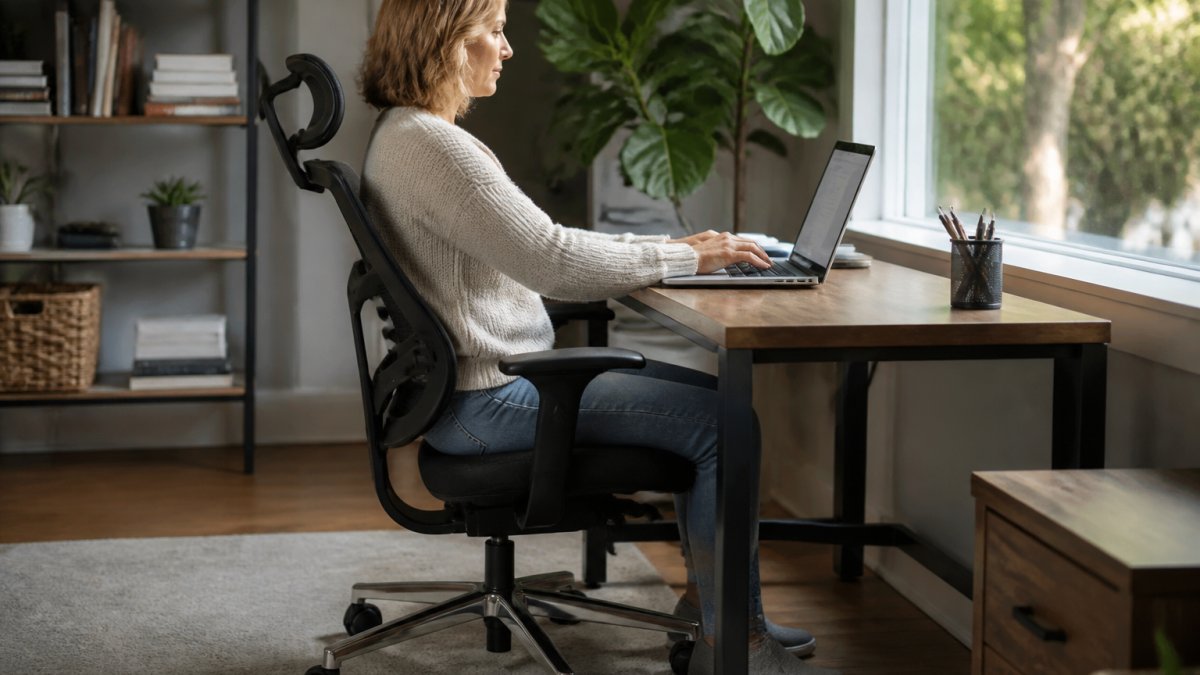
Seat Height and Backrest Positioning
Start with seat height: feet flat on the floor, knees at 90 degrees. If your feet dangle, raise the chair; if your knees sit higher than your hips, lower it. This one adjustment prevents lower-leg tension and improves circulation.
Next, position the backrest to support your lower back's natural curve. Sit back fully, don't perch. The lumbar support should contact your lower back, not your mid-back or tailbone.
Backrest recline should be snug enough that you don't slide forward when you lean back, but loose enough that you can recline slightly for breaks.
Armrest and Lumbar Support Tuning
Armrests should support your forearms at rest with elbows near 90 degrees and shoulders relaxed, not shrugged. You can also perform simple desk exercises to improve spinal alignment throughout your day to complement proper chair adjustment.
Lumbar support height should align with the small of your back, the inward curve just above your hips. Adjust it up or down until it feels like it's supporting exactly where you feel tension.
Watch out: Over-tightening lumbar support can feel good initially but creates tension over hours. If your lower back feels sore after a full day despite good chair adjustment, the support might be too aggressive.
The Limits of Chair Support: When Movement and Professional Care Matter
No chair alone can fix chronic muscle tension caused by poor movement patterns, stress, or underlying musculoskeletal issues.
A good ergonomic chair reduces strain but doesn't eliminate the need for movement. Sitting 8+ hours daily, even in a perfect chair, creates tension, so stand up every 60-90 minutes, walk around, and change positions.
Chronic muscle tension often signals something deeper than poor seating.
This is where evidence-based integrative care becomes valuable. Applied Kinesiology and advanced therapeutic techniques like acoustic wave therapy address the root causes of chronic muscle tension, not just the symptoms. Explore proven non-invasive back pain treatments: spinal decompression, acoustic wave therapy, magnetic resonance, and more. Find relief without surgery. A chiropractor trained in these methods can identify whether your tension stems from muscle dysfunction, nerve involvement, or structural issues that a chair alone won't fix.
The combination works best: a properly adjusted ergonomic chair reduces daily strain, while professional care addresses underlying dysfunction. One without the other leaves you managing symptoms instead of solving the problem.
Request a Consultation to Address Your Muscle Tension
An ergonomic chair is a foundation, not a complete solution. If your chronic muscle tension persists after investing in proper seating, the next step is professional evaluation.
At Alternative Health & Healing Center, we combine nearly 40 years of clinical experience with advanced therapeutic technology to identify why your muscles are holding tension. Our team specializes in Applied Kinesiology, which assesses how your muscles and nervous system are functioning.
Whether your tension stems from postural dysfunction, nerve involvement, or muscular imbalance, we have the expertise and technology to help. Meet Dr. Paul Finucan at Alternative Health & Healing Center in Naples, FL. 40+ years chiropractic expertise + advanced therapies like Magnesphere and PiezoWave 2. Get started with a consultation and discover how integrative care combined with proper ergonomics can restore relief and improve your physical wellness.
Frequently Asked Questions
Can an ergonomic chair help with chronic muscle tension?
A properly adjusted ergonomic chair reduces strain on the neck, shoulders, and lower back by supporting spinal alignment and distributing pressure evenly. However, a chair alone cannot resolve chronic muscle tension. Tension relief depends on proper adjustment, regular movement breaks, and often professional care. An ergonomic chair is one component of a comprehensive approach that includes stretching, posture awareness, and targeted therapeutic treatment for persistent muscle issues.
What features should I look for in the best desk chair for neck pain?
Look for a chair with an adjustable headrest or neck support that allows you to position it at the base of your skull without forcing your head forward. The backrest should support the natural curve of your cervical spine, and the seat should be deep enough to support your thighs without cutting off circulation. Adjustable armrests that support your arms at elbow height reduce shoulder strain, which directly affects neck tension. Tilt and recline options allow you to shift positions throughout the day, preventing sustained muscle strain.
How should I adjust an ergonomic chair to reduce back pain?
Set your seat height so your feet rest flat on the floor with knees at 90 degrees. Position the backrest to support your lower-back curve (lumbar support should contact your lower spine, not your mid-back). Adjust armrests so your elbows are at 90 degrees and your shoulders are relaxed, not shrugged. The seat depth should allow 2-3 fingers of space between the edge and the back of your knees. Recline slightly if your chair allows it, and use the tilt mechanism to shift your weight periodically throughout the day.
Is a firm or soft chair better for muscle tension?
Neither extreme is ideal. A chair that is too soft collapses under your weight and fails to support proper spinal alignment, increasing strain. A chair that is too firm creates pressure points that restrict blood flow and increase tension over time. The best choice is a medium-firm seat with cushioning that supports your body contours without bottoming out, combined with adjustable lumbar support that lets you customize firmness to your spine's natural curve. Your individual body shape and comfort preferences matter more than a universal firmness standard.
An ergonomic chair works best when paired with professional care that addresses the underlying causes of your chronic muscle tension. The right chair supports your body during the workday. The right practitioner helps your body heal and function optimally. Together, they create lasting relief.