 How-to
Fish Oil Dosage for Cognitive Health: 7 Facts to Know
Last Updated: October 29, 2026
Quick Summary
There is no single established fish oil dosage for cognitive health, and the evidence is mixed. Studies have tested combined EPA and DHA amounts often around 500 mg to 2,000 mg per day, with results varying by age and diet. Discuss your personal fish oil dosage with a clinician before choosing a number.
- Compare the combined EPA plus DHA amount on the label, not the total fish oil weight.
- Studies have often used about 500 mg to 2,000 mg of combined EPA and DHA daily.
- Evidence for cognitive benefit is thinnest in healthy younger adults without memory complaints.
- Fish oil may raise bleeding risk, so check with a prescriber if you take blood thinners.
Table of Contents
- What Omega-3 Fatty Acids Are and How EPA and DHA Differ
- What the Research Says About Omega-3s and Brain Health
- Omega-3 Dosage for Brain Health: Daily Ranges Used in Studies
- EPA and DHA Dosage for Memory: Reading the Numbers Correctly
- How to Read Fish Oil Supplement Labels
- Fish Oil Side Effects, Safety, and Medication Interactions
- Booking a Consultation to Build Your Own Dosing Plan
- Frequently Asked Questions
What Omega-3 Fatty Acids Are and How EPA and DHA Differ
Omega-3 fatty acids are essential fats your body cannot make on its own, so you must get them from food or supplements. The three main types are ALA, EPA, and DHA. Fish oil supplements usually provide EPA and DHA, the two forms most studied for brain health, so understanding fish oil dosage starts with knowing what these fats are.
EPA and DHA do different jobs. EPA is more linked to inflammation and heart health. DHA is a major structural fat in brain tissue, which is why it draws so much attention in cognitive research. When you read a label, the two numbers are not interchangeable.
Watch out: a bottle that says "1,000 mg fish oil" does not mean 1,000 mg of EPA and DHA. The active amount is usually much lower.
Best for: readers who want the basics before they look at any dose numbers.
What the Research Says About Omega-3s and Brain Health
Researchers have studied omega-3s and thinking skills for decades. The results have been mixed. Some studies suggest benefits for memory, while others find little effect in healthy adults.
The evidence differs by group. Most studies tested older adults, people already showing memory decline, or those at risk; results in healthy younger adults are much less clear. Many researchers say larger, longer trials are needed before strong conclusions.
Research on omega-3s is ongoing. The National Institutes of Health's Office of Dietary Supplements is a good place to check current summaries of the evidence.
Omega-3 Dosage for Brain Health: Daily Ranges Used in Studies
There is no single established "cognitive dose" of fish oil. Instead, three layers matter in any fish oil dosage decision: general dietary guidance, doses used in cognition research, and safety ceilings. Keeping them separate is the most useful skill before choosing a number.
Layer 1: General dietary guidance (established)
Federal dietary guidance recommends seafood as part of a healthy eating pattern, and the Dietary Guidelines for Americans identify seafood as an omega-3 source. Check the current Dietary Guidelines for specific weekly seafood recommendations. This layer is best-established: population-level nutrition guidance, not a treatment protocol.
Layer 2: Doses studied for cognition (variable, not a prescription)
Cognition trials have used a wide spread of combined EPA and DHA doses, and results depend on study populations, duration, baseline diet, and the EPA-to-DHA ratio. A dose that appeared in a study is a study parameter, not a recommended target; study populations, duration, baseline diet, and the EPA-to-DHA ratio all shift results.
A practical way to grade the evidence for yourself:
- Strongest evidence base: general dietary seafood intake for overall health.
- Mixed / population-specific evidence: omega-3 supplementation for memory and thinking in older adults, especially those with mild cognitive concerns.
- Weakest evidence: supplementation in healthy younger adults with no cognitive complaints, most trials here find little to no measurable effect.
Layer 3: Personalizing the range
A few practical rules of thumb help translate study doses into something meaningful for an individual:
- If you already eat fatty fish twice a week, you are likely near the general guidance target, and the marginal cognitive benefit of a supplement is less clear.
- If you rarely eat fish, a supplement in the lower-to-middle studied range (roughly 500-1,000 mg combined EPA and DHA) is a common starting point discussed with a clinician.
- If you are an older adult or have noticed memory changes, the most relevant studies are in older or cognitively at-risk populations, but results are still mixed, and a clinician should weigh them against your medications and conditions.
- If you are a healthy younger adult, evidence for cognitive benefit is thinnest; general dietary intake is the better-grounded goal.
Safety ceiling to keep in mind
Federal safety guidance sets upper intake levels for combined EPA and DHA; check the current FDA guidance or ask a clinician for the figures that apply to you. That ceiling is a safety boundary, not a cognitive target; there is no evidence that pushing toward it improves thinking skills.
Best for: readers who want to separate general nutrition guidance from cognition-study doses and safety limits before picking a number. Skip if: you are looking for a single "correct" cognitive dose, the evidence does not support one.
EPA and DHA Dosage for Memory: Reading the Numbers Correctly
Memory studies often report "omega-3 dose" without saying which fat it refers to. A study giving 800 mg of DHA is very different from one giving 800 mg of total fish oil.
Here is a simple way to think about it:
- Total fish oil: the full capsule weight
- Combined EPA and DHA: the active omega-3 amount
- DHA alone: often the number most tied to brain tissue research (Source: National Institutes of Health's Office of Dietary Supplements)
Many people compare products by the total capsule weight. That is a mistake. Compare the EPA plus DHA line instead.
| Label Item | What It Means | What to Check |
|---|---|---|
| Fish oil (total) | Whole capsule weight | Not the active dose |
| EPA | One omega-3 type | Read the milligram amount |
| DHA | Brain-focused omega-3 | Read the milligram amount |
| Combined EPA + DHA | Active omega-3 total | The number to compare |
How to Read Fish Oil Supplement Labels
Labels are where most dosing mistakes happen. Find the combined EPA plus DHA per serving, then compare that number, not total fish-oil milligrams, to the range you and your clinician discussed. Here is how, plus quality signals beyond the dose.
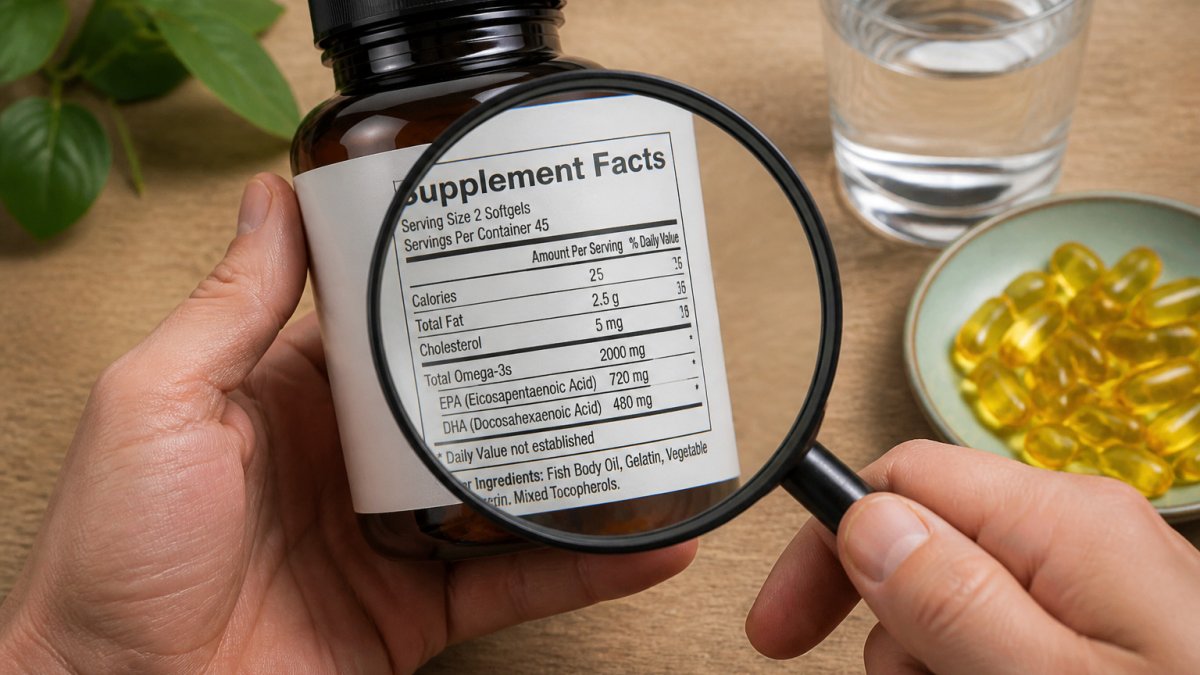
Step-by-step label math
- Find the Supplement Facts panel (not the front-of-bottle marketing).
- Check the serving size. Many products list two or three softgels as one serving; the EPA and DHA numbers apply to that whole serving, not to each capsule.
- Locate the EPA and DHA lines and note the milligram amounts.
- Add EPA + DHA to get the combined active amount per serving.
- Divide by the number of capsules per serving if you want a per-capsule figure.
- Compare that combined number to the range you are considering, not to the "fish oil" total.
Worked example across three label styles
| Label style | Serving size | Fish oil (total) | EPA | DHA | Combined EPA + DHA per serving | Per capsule |
|---|---|---|---|---|---|---|
| Standard 1,000 mg softgel | 1 softgel | 1,000 mg | 180 mg | 120 mg | 300 mg | 300 mg |
| Concentrated softgel | 2 softgels | 1,400 mg | 500 mg | 200 mg | 700 mg | 350 mg |
| High-potency capsule | 1 capsule | 1,200 mg | 400 mg | 300 mg | 700 mg | 700 mg |
Notice the trap: the standard softgel shows the largest "fish oil" number (1,000 mg) but delivers the least combined EPA + DHA (300 mg). The high-potency capsule shows a similar total but nearly 2.3 times the active amount. Comparing front labels would lead you to the wrong conclusion.
Serving-size and "other omega-3" traps
- Serving size inflation: a bottle that says "1,000 mg omega-3 per serving" may define a serving as two or three capsules. Always check.
- "Other omega-3" lines: some labels include ALA or minor omega-3s in the total. For cognition-relevant EPA and DHA, use only those two lines.
- Round-number marketing: a front label of "2,000 mg fish oil" tells you nothing about active dose until you read the panel.
Quality signals beyond the dose
Dose is only half the decision. Oxidation and purity affect whether the product is worth taking at all.
- Third-party testing seals: USP Verified, NSF International, or ConsumerLab-style marks indicate testing for potency, contaminants, and sometimes freshness.
- Freshness and oxidation: oxidized fish oil smells rancid and may be less useful. Signs include a strong fishy or rancid odor when opening the bottle, an unusually harsh burp-back taste, or a "best by" date that is close or passed. Store cool and dark; consider refrigerating after opening.
- Form and absorption: triglyceride, ethyl ester, and re-esterified triglyceride forms differ in absorption; enteric coating may reduce aftertaste but does not necessarily improve absorption.
- Contaminants: reputable brands test for heavy metals (mercury, lead) and PCBs; third-party seals are the easiest proxy.
Putting it together
Once you have the combined EPA + DHA per serving, compare it to the range you and your clinician discussed, then check quality signals. A product delivering 600-700 mg combined EPA + DHA per serving with a third-party seal and a distant "best by" date is more defensible than a cheaper bottle with a bigger front-label number and no verification.
Best for: anyone comparing two or more bottles and wanting a repeatable calculation plus quality checklist. Skip if: you have not yet discussed a target range with a clinician, do the dose conversation first, then use this section to shop.
Fish Oil Side Effects, Safety, and Medication Interactions
Fish oil is generally well tolerated for most adults. Common side effects include fishy aftertaste, nausea, heartburn, and loose stools. Taking capsules with meals or splitting the dose can help.
Higher doses carry more risk. Fish oil may increase bleeding risk, especially for people taking blood thinners such as warfarin or aspirin, and can interact with some blood pressure medications and other drugs.
Best for: anyone comparing supplement options who wants a clear safety checklist. Skip if: you already take prescription blood thinners and have not discussed fish oil with your prescriber.
Booking a Consultation to Build Your Own Dosing Plan
Every body responds differently, and no single number fits everyone. Age, diet, medications, and cognitive health all shape what makes sense. Alternative Health & Healing Center in Naples, Florida, offers consultations focused on whole-person care. Consult a qualified health professional before building a dosing plan.
During a visit, bring your supplement bottles, a list of medications, and any memory concerns you have noticed. You can find out more about our services and how to schedule at book a consultation with Alternative Health & Healing Center.
For background on the broader approach, read what holistic care means.
Frequently Asked Questions
How much fish oil should I take for cognitive health?
Studies on cognitive outcomes have used a range of combined EPA and DHA amounts, and results vary across trials and populations. Dosage depends on your age, diet, baseline fish intake, and any medications you take. Because the evidence for cognitive benefit in healthy adults is mixed, the amount you choose should be discussed with a qualified health professional who can review your individual situation before you start.
How much EPA and DHA should a fish oil supplement contain for brain health?
Supplement labels often list total fish oil per capsule, which can differ from the combined EPA and DHA content. Check the Supplement Facts panel for the milligram amounts of EPA and DHA specifically, then add them together to find your daily total. Research on memory and thinking skills has generally used combined EPA and DHA amounts rather than total fish oil weight, so the distinction matters when comparing products.
Can you take too much fish oil?
Higher intakes of omega-3 fatty acids can increase the risk of side effects such as stomach upset, loose stools, and a tendency toward bleeding, especially in people taking blood-thinning medications. Long-term high-dose use is not recommended without medical supervision. Anyone with a bleeding disorder, an upcoming surgery, or a regular prescription medication should speak with a clinician before taking fish oil at any dose.