 how-to
How to Improve Posture While Working From Home
Table of Contents
- Why Posture Matters When Working From Home
- Set Up an Ergonomic Home Office Setup
- Master Proper Sitting Posture Techniques
- Posture Correction Exercises for Desk Workers
- Build Micro-Break Routines Into Your Workday
- Benefits of Integrative Chiropractic Care for Posture
- Common Mistakes to Avoid
- Frequently Asked Questions
Last Updated: August 20, 2026
Why Posture Matters When Working From Home
Poor posture while working from home creates neck strain, shoulder tension, lower back pain, and chronic musculoskeletal issues that compound over time. Working from home removes environmental accountability, and small setup errors, wrong chair height, misaligned monitor, poor lumbar support, accumulate into significant problems.
At Alternative Health & Healing Center, we've worked with countless remote workers who developed chronic pain from years of poor desk habits. The good news is that posture correction is entirely within your control. Better alignment means reduced strain on your joints, less muscle fatigue, and improved long-term health outcomes. This guide walks you through the exact setup, techniques, and exercises that create lasting postural improvement for remote workers.
Set Up an Ergonomic Home Office Setup
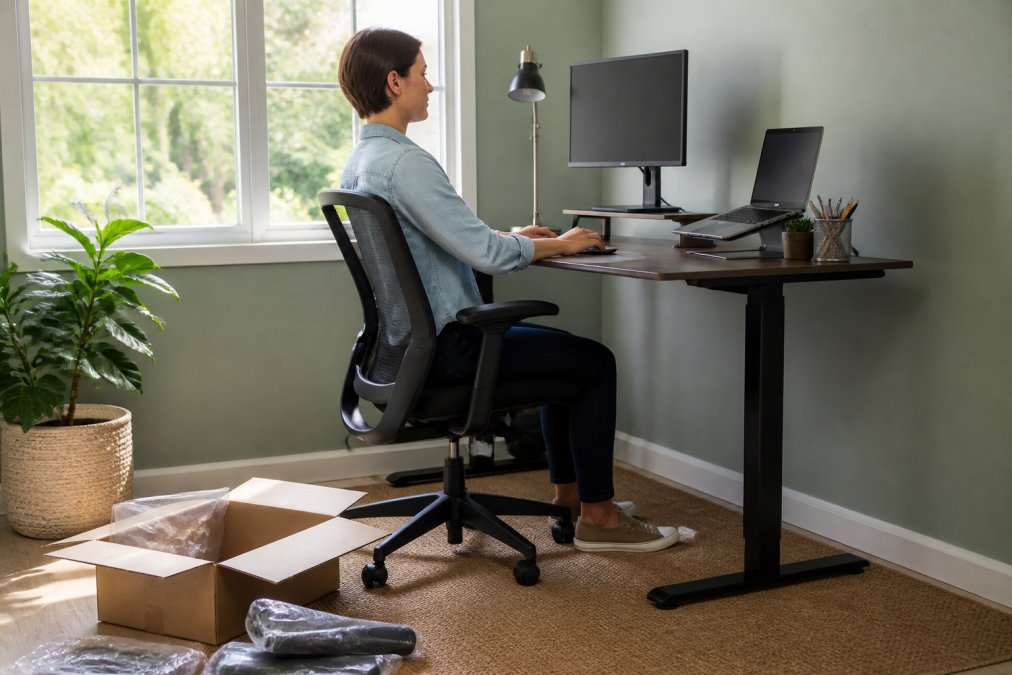
Your workspace environment determines whether good posture is easy or impossible. An ergonomic setup removes the friction that makes bad posture the default choice.
Chair Height and Lumbar Support
Your seat height should allow your feet to rest flat on the floor with your knees at approximately 90 degrees and hips slightly higher than knees. This positioning promotes neutral spine alignment and prevents forward slouching. Look for a chair with firm lumbar support that matches the natural inward bend of your lower spine, preventing your pelvis from tilting backward and flattening your lumbar curve.
If your current chair lacks adequate lumbar support, a lumbar pillow is an inexpensive fix. Position it at belt height behind your lower back and adjust until it feels supportive without excessive pressure. Many remote workers find this single element reduces back pain within days.
Monitor Placement and Eye Level
The top of your monitor should be at or slightly below eye level when sitting upright. Your gaze should naturally fall on the upper third of the screen without tilting your head. Position your monitor about an arm's length away, roughly 20-26 inches from your eyes.
If your monitor is too low, you'll slouch forward and strain your neck. If it's too high, you'll extend your neck backward, compressing your cervical spine. If you use a laptop, prop it on a stand to raise the screen to eye level.
Keyboard and Mouse Positioning
Your keyboard and mouse should be positioned so your elbows stay close to your body at 90-degree angles, with wrists neutral. Many remote workers position their keyboard too high or too far away, forcing them to reach and elevate their shoulders. Your keyboard should sit at elbow height, and your mouse should be at the same height and positioned close enough that you don't have to extend your arm.
If you use a laptop keyboard, use an external keyboard and mouse. This lets you position the screen at eye level while keeping your keyboard at elbow height.
Master Proper Sitting Posture Techniques
Correct sitting posture reduces strain on your joints and muscles through neutral spine alignment, hip alignment, and proper foot and knee support.
Achieving Neutral Spine Alignment
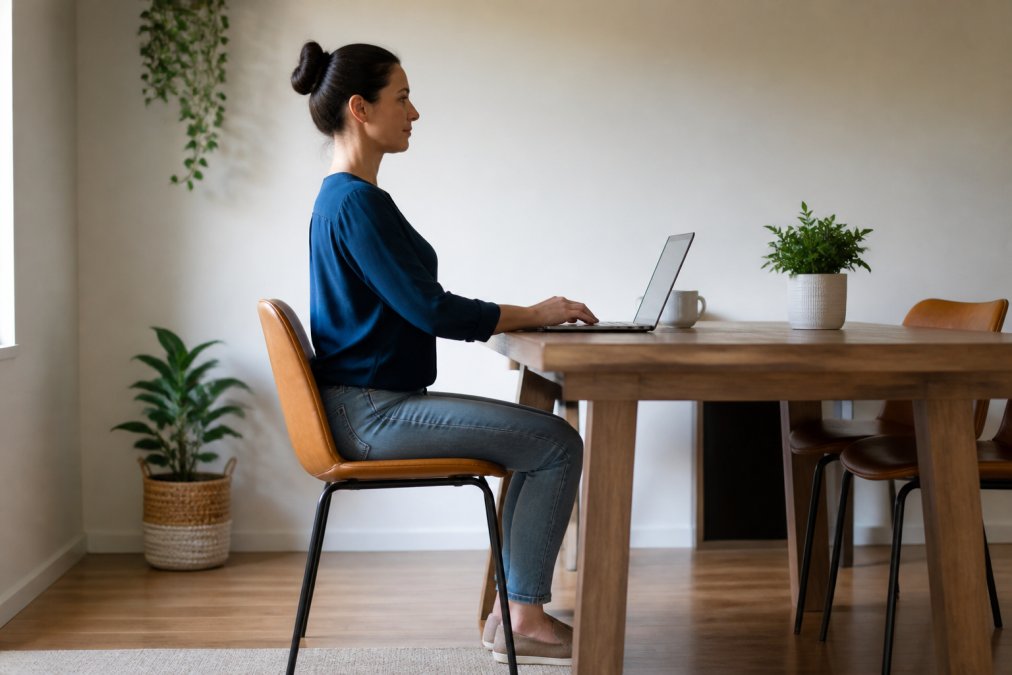
Neutral spine alignment means your vertebrae stack directly on top of each other with minimal stress on your discs and ligaments. Your spine has natural curves: inward in your neck, outward in your mid-back, and inward in your lower back. Good posture maintains these curves.
Sit upright with shoulders relaxed. Your ears should align vertically with your shoulders, not jutting forward. Your chest should be open. Your lower back should maintain its natural inward curve. The most common error is forward head posture, where your head drifts forward of your shoulders. Each inch your head moves forward increases the load on your neck muscles by roughly 10 pounds. Catch yourself when your head drifts forward and reset it back over your shoulders.
Hip Alignment and Pelvic Tilt
Proper hip alignment means your hips are at 90 degrees or slightly higher than your knees, with your pelvis neutral. Posterior pelvic tilt, the most common error among desk workers, tilts your pelvis backward, flattening your lower back and compressing your discs.
To correct this, engage your core slightly and tilt your pelvis forward just enough to restore the natural curve in your lower back. Your lumbar support should assist this alignment by preventing posterior pelvic tilt.
Feet Flat on Floor and Knee Angle
Both feet should rest flat on the floor with your weight distributed evenly. Your knees should be at 90 degrees or slightly greater. This creates stability throughout your lower body and prevents your pelvis from tilting backward.
Avoid crossing your legs or tucking one foot under you, as this creates asymmetrical loading on your spine. If your feet don't reach the floor comfortably, use a footrest.
Posture Correction Exercises for Desk Workers
Sitting correctly is only half the solution. Your muscles need active engagement and stretching to counteract prolonged sitting.
Stretches for Neck and Shoulder Relaxation
Neck flexion stretch: Sit upright and gently drop your chin toward your chest. Hold for 20-30 seconds.
Lateral neck stretch: Tilt your right ear toward your right shoulder. Hold for 20-30 seconds, then repeat on the other side.
Shoulder rolls: Roll your shoulders backward in slow, controlled circles. Complete 10-15 rolls, then reverse direction.
Doorway chest stretch: Stand in a doorway with your forearm against the frame, elbow at 90 degrees. Step forward until you feel a stretch across your chest. Hold for 20-30 seconds on each side.
Core Engagement Exercises
Dead bug: Lie on your back with arms extended toward the ceiling and knees bent at 90 degrees. Slowly lower your right arm behind your head while straightening your left leg, hovering just above the floor. Return to start and repeat on the other side. Complete 10-12 repetitions per side.
Glute bridge: Lie on your back with knees bent and feet flat. Push through your heels and lift your hips until your body forms a straight line from knees to shoulders. Squeeze your glutes at the top. Hold for 1-2 seconds and lower. Complete 12-15 repetitions.
Plank hold: Support yourself on your forearms and toes with your body in a straight line. Engage your core and avoid letting your hips sag. Hold for 20-30 seconds, rest, and repeat for 3 sets.
Spinal Alignment Movements
Cat-cow stretch: Start on your hands and knees. Arch your back, lift your head and chest (cow position), then round your spine, drop your head, and tuck your pelvis under (cat position). Flow between these positions for 10-12 repetitions.
Child's pose: From hands and knees, sink your hips back toward your heels and extend your arms forward. Rest your forehead on the ground. Hold for 30-45 seconds.
Sphinx stretch: Lie face down and prop yourself up on your forearms with elbows directly under your shoulders. Gently press your hips into the floor and arch your upper back. Hold for 20-30 seconds.
Build Micro-Break Routines Into Your Workday
Sitting perfectly for eight hours is less important than moving regularly throughout the day. Set a timer for every 45 minutes and do one of these quick routines:
Two-minute movement break: Stand and do 10 shoulder rolls backward, 10 neck flexion stretches, and 20 seconds of gentle spinal twists.
Walking break: Walk to another room or around your home for 2-3 minutes.
Stretching break: Do the doorway chest stretch, lateral neck stretch, and a forward fold. Hold each for 20-30 seconds.
These micro-breaks take minimal time but create significant cumulative benefits. Remote workers who take regular movement breaks report less pain and better postural awareness throughout the day.
Benefits of Integrative Chiropractic Care for Posture
While self-directed posture improvement works for many people, integrative chiropractic care can be a valuable complement to your efforts and address underlying issues that exercises alone may not fully resolve. Applied Kinesiology, a specialization at Alternative Health & Healing Center, combines spinal adjustments, muscle testing, and therapeutic modalities to restore proper alignment and function.
A chiropractor trained in Applied Kinesiology can identify postural imbalances. They test muscle strength and joint mobility to find restrictions that contribute to poor posture, then use targeted adjustments and therapeutic techniques to support normal spinal alignment and muscle function.
The Piezo Wave 2 technology that Alternative Health & Healing Center uses represents an advanced approach to treating musculoskeletal problems related to posture. This acoustic wave therapy addresses soft tissue restrictions that limit mobility and contribute to postural dysfunction. Combined with chiropractic adjustments and therapeutic exercises, this technology can help restore the movement quality necessary for sustainable posture improvement.
Integrative chiropractic care is particularly valuable if you have chronic pain, previous injuries, or significant postural dysfunction. A professional assessment identifies whether your posture problems stem from muscle weakness, joint restrictions, nerve involvement, or structural imbalances.
Common Mistakes to Avoid
Assuming perfect posture is sustainable: Rigid, perfectly aligned posture is uncomfortable and unsustainable. Your goal is neutral alignment that feels natural and can be maintained throughout the day.
Ignoring your setup: You can't maintain good posture in a poorly designed workspace. Fix your environment first.
Skipping stretching and strengthening: Posture improvement requires both alignment changes and muscle development.
Expecting instant results: Postural change takes weeks to become habitual. Consistency matters more than intensity.
Neglecting the psychological component: Stress, anxiety, and poor mental health cause you to collapse inward and adopt protective postures.
Sitting for too long without movement: Even perfect posture becomes problematic if you maintain it for hours without breaks.
Improving your posture while working from home is achievable through environmental changes, correct technique, and consistent practice. Setup modifications remove the friction that makes bad posture the default. Exercises and stretches build strength and flexibility. Micro-breaks maintain awareness and prevent cumulative strain.
If you've tried self-directed posture improvement without success, or if you have chronic pain related to posture, integrative chiropractic care can accelerate your progress. Alternative Health & Healing Center combines nearly 40 years of clinical experience with advanced technology like the Piezo Wave 2 to address the underlying restrictions that limit your posture improvement. Applied Kinesiology identifies the specific imbalances affecting your alignment and treats them with targeted adjustments and therapeutic modalities. Request an appointment with Alternative Health & Healing Center to get a professional assessment of your posture and a personalized treatment plan designed to restore your spinal alignment and eliminate pain.
Frequently Asked Questions
Can you correct years of bad posture?
Yes, postural awareness and consistent practice can improve posture at any age. The longer slouching patterns have existed, the more time improvement takes, but your body adapts to new positioning within weeks. Stretching, core engagement exercises, and ergonomic adjustments work together to retrain muscle memory. Many people notice relief from neck strain and shoulder tension within 2-4 weeks of maintaining proper alignment. For chronic cases or complex musculoskeletal issues, integrative chiropractic care can accelerate results by addressing underlying joint dysfunction and muscle imbalances.
How do I stop slouching at my desk?
Slouching happens because muscles fatigue when holding neutral spine. Start by adjusting your chair height so your forearm support is natural and your feet rest flat on the floor. Set a phone timer for 30-minute intervals as a reminder to check your posture. When you notice slouching, perform a quick reset: roll your shoulders back, lengthen your spine upward, and ensure your monitor is at eye level. Core engagement exercises strengthen the muscles that support upright posture, making it feel less exhausting over time.
How often should I take movement breaks to improve posture?
Micro-breaks every 30 minutes are most effective for preventing postural fatigue and repetitive strain. Stand, stretch, and walk for 2-3 minutes. This resets muscle tension, improves circulation, and gives your spine a break from sustained sitting. Even brief movement interrupts sedentary behavior and prevents the muscle tightness that leads to slouching. If 30 minutes feels too frequent, aim for at least one 5-minute break per hour. The key is consistency, regular small breaks prevent the accumulated strain that causes neck and shoulder pain.
Does integrative chiropractic care help with posture-related pain?
Integrative chiropractic care addresses both postural habits and the underlying joint and muscle dysfunction that causes pain. Applied Kinesiology and spinal alignment therapies correct misalignments that develop from poor posture, while therapeutic modalities reduce muscle tension and inflammation. This combined approach treats the root cause rather than just symptoms. Many patients experience relief from musculoskeletal and nerve pain while learning better postural habits. A consultation with a qualified chiropractor can determine whether your specific condition will benefit from integrative care alongside posture correction exercises and ergonomic adjustments.


