 how-to
How to Improve Posture with Applied Kinesiology
Table of Contents
- How Applied Kinesiology Assesses Postural Alignment
- Muscle Testing for Posture: What to Expect During an Exam
- Chiropractic Care for Postural Alignment: How It Fits with AK
- Targeted Corrective Exercises for Postural Correction
- How to Restore Body Function Naturally Through AK
- Self-Assessment Protocols and the Limits of the Evidence
- Conclusion: Building a Posture Plan That Lasts
- Frequently Asked Questions
Last Updated: September 16, 2026
How Applied Kinesiology Assesses Postural Alignment
Applied kinesiology is a diagnostic approach that uses manual muscle testing to identify weaknesses and imbalances that make it harder to improve posture. At Alternative Health & Healing Center, we've used this method for decades to trace postural problems back to their source rather than treating symptoms alone.
The logic is straightforward: your body compensates. When one muscle weakens, others tighten to pick up the slack. Over time, those compensatory patterns pull your spine, hips, and shoulders out of alignment. A practitioner trained in AK reads those patterns through targeted muscle tests, mapping which links in the kinetic chain have stopped doing their job.
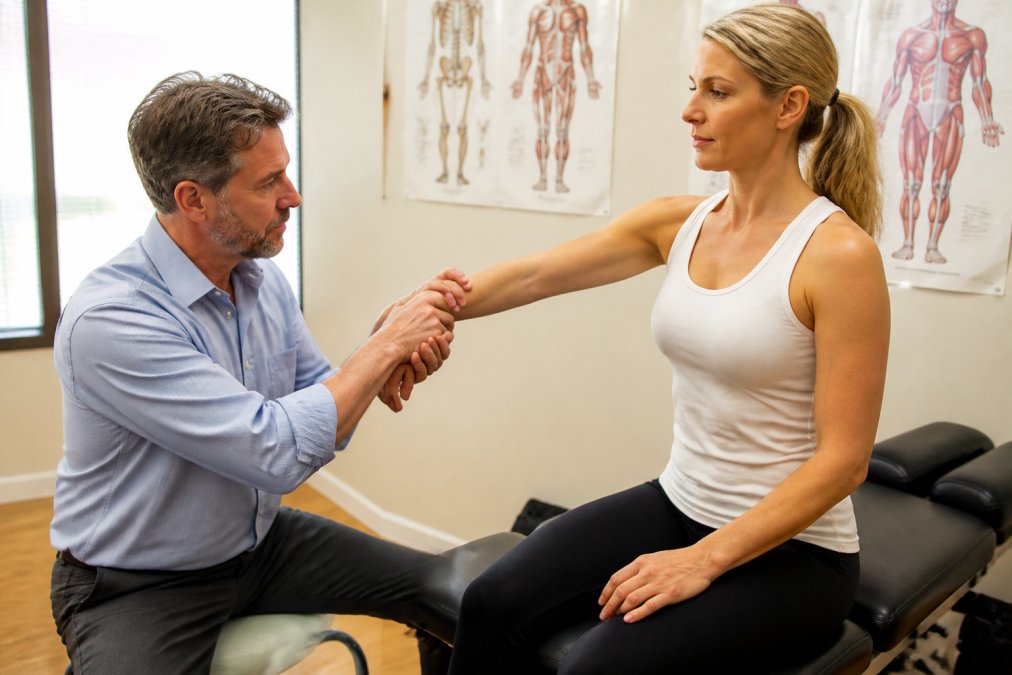
This isn't guesswork. Manual muscle testing gives the practitioner immediate somatic feedback. A muscle that should hold firm against gentle resistance but gives way tells a specific story about nerve interference, joint dysfunction, or myofascial restriction.
The Connection Between Muscle Weakness and Postural Strain
Muscle weakness rarely stays local. A weak glute medius tilts the pelvis. A tilted pelvis rotates the thoracic spine. A rotated thoracic spine forces the cervical spine to compensate, and suddenly you have neck pain that has nothing to do with your neck.
Many patients arrive with pain in one area and are surprised when an assessment points somewhere else entirely. That's the value of looking at the whole kinetic chain instead of chasing the symptom.
Muscle Testing for Posture: What to Expect During an Exam
A posture-focused muscle testing exam typically takes 30 to 45 minutes and involves four stages:
- Postural observation. The practitioner watches you stand, sit, and walk, noting pelvic tilt, shoulder height, and head position.
- Manual muscle testing. You resist gentle pressure in specific positions. Weak responses flag areas needing attention.
- Challenge testing. The practitioner introduces a corrective input, such as a spinal adjustment or joint mobilization, then retests the same muscle. If it strengthens immediately, that confirms the correction addressed the underlying issue.
- Functional movement screening. You perform basic movements like a squat or overhead reach to see how the corrections hold under load.
What most guides miss is that the retest matters more than the initial finding. A weak muscle tells you something is wrong. A muscle that strengthens after a specific correction tells you what was wrong.
Chiropractic Care for Postural Alignment: How It Fits with AK
Chiropractic care for postural alignment and applied kinesiology work best as a pair. The adjustment restores joint mobility; the muscle testing confirms whether the adjustment actually changed neuromuscular function. Without that confirmation, you're adjusting blind.
A common mistake is assuming that a crack equals a correction. In practice, an adjustment that doesn't restore muscle facilitation won't hold. The body will drift back into its compensatory pattern within days.
At Alternative Health & Healing Center, we combine spinal adjustments with myofascial release, joint mobilization, and acoustic wave therapy using the Piezo Wave 2. The goal is to address the joint, the soft tissue, and the neurological feedback loop in the same session.
Targeted Corrective Exercises for Postural Correction
Corrective exercises only work when they target the specific weak links your assessment identified. Generic posture routines waste time on muscles that are already doing their job.
| Postural Problem | Likely Weak Link | Corrective Focus |
|---|---|---|
| Forward head posture | Deep cervical flexors | Chin tucks, cervical stabilization |
| Rounded shoulders | Lower trapezius, serratus anterior | Wall slides, prone Y-raises |
| Anterior pelvic tilt | Glutes, deep core | Dead bugs, glute bridges |
| Thoracic kyphosis | Thoracic extensors | Foam roller extensions, prone press-ups |
Perform corrective exercises daily for the first two weeks, then three to four times weekly for maintenance. Consistency beats intensity here. Five focused minutes daily outperforms one 45-minute session per week.
Daily Ergonomic Habits That Support Lasting Change
Corrective exercises improve posture; ergonomic habits help you keep it. An ergonomic assessment of your workspace usually reveals two or three fixable problems: screen height, chair support, and how long you sit without moving.
Set your monitor so the top third sits at eye level. Support your lumbar curve with a cushion or an adjustable chair. Stand and move every 30 minutes, even if only for a minute. These small changes protect the alignment you're working to restore.
How to Restore Body Function Naturally Through AK
Restoring body function naturally means removing the interference that prevents your nervous system from coordinating muscles correctly. AK does this by identifying neuromuscular re-education targets, then using adjustments, soft tissue work, and targeted exercise to restore proper signaling.
The process follows a predictable arc. First, reduce pain and inflammation so movement becomes possible. Next, restore joint mobility and muscle facilitation. Finally, rebuild functional movement patterns through progressive loading. Skipping to the exercise phase before the first two are complete is why so many home programs fail.
What separates a real AK-based recovery plan from a generic stretching routine is that every step is tied to a specific muscle test result. If your practitioner finds that your lower trapezius gives way during a prone Y-raise test, the plan isn't 'do more back exercises', it's a sequenced protocol that addresses the nerve interference, joint restriction, or myofascial adhesion that's shutting that muscle down, then reloads it progressively.
A typical four-phase arc looks like this:
- Down-regulate pain and inflammation. Manual therapy, myofascial release, and, where indicated, modalities such as acoustic wave therapy reduce the guarding that masks true muscle function. Testing a muscle while it's in spasm tells you almost nothing useful.
- Restore joint mobility. Spinal adjustments and joint mobilization remove the mechanical restriction that feeds faulty proprioceptive input back to the brain. This is where the challenge-retest step earns its keep: if the muscle strengthens immediately after the adjustment, you've confirmed the joint was the driver.
- Re-educate neuromuscular signaling. Specific activation drills, often isometric holds at low load, teach the weak muscle to fire again in coordination with its synergists. This is the phase most home programs skip entirely.
- Rebuild functional patterns under load. Only once the muscle holds a basic test do you progress to compound movements like squats, carries, and overhead reaches that mirror real life.
For patients dealing with complex conditions like fibromyalgia or autoimmune-related pain, this root-cause approach often uncovers compensatory patterns that standard treatments overlook. The National Center for Complementary and Integrative Health overview of complementary approaches notes that integrative methods are increasingly studied for chronic musculoskeletal conditions, though evidence quality varies across techniques.
Self-Assessment Protocols and the Limits of the Evidence
You can run a basic self-assessment at home. Stand in front of a mirror and check four things: are your shoulders level, is your head centered over your shoulders, is your pelvis level, and do your feet point straight ahead? Any asymmetry suggests a compensatory pattern worth investigating.
What home assessment cannot do is identify which muscle is weak or why. That requires manual muscle testing and challenge testing by a trained practitioner.
Honest limitation: applied kinesiology's evidence base is mixed. Some studies support manual muscle testing's reliability for specific applications; others question its consistency between practitioners. The PubMed database of peer-reviewed kinesiology research hosts studies on both sides. AK works best as part of a broader clinical assessment, not as a standalone diagnostic tool.
Conclusion: Building a Posture Plan That Lasts
Lasting postural change requires assessment, correction, and daily reinforcement, not a one-time fix. Most people who fail at posture improvement skip the assessment step and jump straight to generic exercises that never address their actual weak links.
At Alternative Health & Healing Center, we combine nearly 40 years of clinical experience with Applied Kinesiology, chiropractic care, and advanced technology like the Piezo Wave 2 to build posture plans around your specific patterns. Our integrative approach addresses the joint, muscle, and neurological components together so corrections actually hold.
Request an appointment with Alternative Health & Healing Center and get a posture plan built around what your body actually needs.
Frequently Asked Questions
Does applied kinesiology really work for postural correction?
Applied kinesiology is used by some chiropractors and integrative practitioners to identify muscle imbalances that affect posture. Research on manual muscle testing has limitations, and results vary by practitioner and patient. Many people report improved postural awareness and reduced discomfort when AK is combined with corrective exercises and ergonomic changes. Talk with a qualified provider about whether this approach fits your situation.
How does muscle testing for posture identify imbalances?
During muscle testing for posture, a practitioner applies gentle pressure to specific muscles while you resist. Weak or poorly facilitated muscles may point to compensatory patterns elsewhere in the kinetic chain. The practitioner then checks whether correcting those patterns improves overall alignment. It is a hands-on assessment tool, not a standalone diagnosis, and works best alongside a full clinical exam.
Can I correct years of bad posture through holistic care?
Years of postural strain do not reverse overnight, but consistent holistic care can help. A plan that combines chiropractic care for postural alignment, targeted corrective exercises, and daily ergonomic adjustments often produces gradual improvement in comfort and mobility. Progress depends on your age, underlying conditions, and how consistently you follow the plan. Set realistic expectations with your provider.
How do I restore body function naturally without relying on medication?
To restore body function naturally, focus on three areas: restoring joint mobility through hands-on care, retraining weak muscles with corrective exercises, and reducing daily strain through better ergonomics. Applied kinesiology practitioners often combine these with manual therapy and lifestyle guidance. Natural approaches can complement medical care, so keep your physician informed about any treatments you add.


