 listicle
Natural Topical Remedies for Knee Pain Relief That Work
Table of Contents
- Which Natural Topical Remedies for Knee Pain Relief Actually Work?
- How Topical Remedies Differ from Oral Pain Relievers
- Capsaicin Cream for Joint Pain: What the Evidence Shows
- Arnica Montana for Knee Inflammation and Bruising
- Menthol, Turmeric, and Ginger: Cooling and Warming Options
- How to Apply Topical Remedies Safely for Knee Pain Relief
- When Topicals Aren't Enough: Holistic Knee Pain Management
- Your Next Step Toward Lasting Knee Relief
- Frequently Asked Questions
Last Updated: September 8, 2026
Which Natural Topical Remedies for Knee Pain Relief Actually Work?
Knee pain relief often starts with what you put on your skin, not what you swallow. Natural topical remedies for knee pain relief target the source of discomfort directly, offering localized relief without the systemic side effects of oral medications. At Alternative Health & Healing Center, we regularly counsel patients on integrating these options into a broader care plan.
The most effective natural topicals fall into a few evidence-backed categories: capsaicin for nerve-related pain signaling, arnica for inflammation and bruising, and cooling agents like menthol for temporary numbing. Each works through a different mechanism, so the right choice depends on your specific symptoms.
Below, we break down which remedies have real support, how to apply them correctly, and when topical care reaches its limits.
How Topical Remedies Differ from Oral Pain Relievers
Topical analgesics deliver active ingredients through the skin directly to the tissues beneath, bypassing the digestive system and liver. This targeted approach means lower doses reach the bloodstream, reducing the risk of gastrointestinal and cardiovascular side effects sometimes linked to oral NSAIDs.
The trade-off is depth of action. Many over-the-counter topicals provide superficial relief, numbing the skin and superficial tissues without addressing deeper joint inflammation. National Institutes of Health overview of topical analgesics notes that while topical formulations can be effective for localized pain, their penetration is limited compared to systemic options. Understanding this limitation helps set realistic expectations: topicals excel at calming surface-level muscle spasms and mild joint stiffness, not at resolving advanced cartilage deterioration.
Capsaicin Cream for Joint Pain: What the Evidence Shows
Capsaicin, the compound that gives chili peppers their heat, is one of the most extensively studied natural ingredients for joint discomfort. It works by depleting substance P, a neuropeptide involved in transmitting pain signals to the brain. With consistent application, typically three to four times daily for two to four weeks, many users experience meaningful reduction in chronic knee pain.
The clinical evidence is respectable. A 2016 Cochrane review found that high-concentration (8%) patches provided moderate pain relief in a minority of participants, while lower-concentration creams (0.025%-0.075%) showed more modest but measurable benefits. The American College of Rheumatology's 2019 guideline conditionally recommends topical capsaicin for knee osteoarthritis.
A common mistake is expecting immediate results. Capsaicin requires a loading period, and the initial warming or burning sensation can discourage people before the therapeutic effect develops. Start with a low-concentration product (0.025% or 0.05%) and apply a thin layer no more than three times daily. Avoid broken skin and hot showers around application time, as heat increases absorption and intensifies burning. Wash your hands thoroughly after application.
A DIY cayenne pepper paste mixed with olive oil offers an extremely low-cost alternative, but homemade preparations carry real risks: concentration is difficult to control, and severe skin irritation is possible. Commercial products provide more predictable dosing and are the safer starting point for most people.
Capsaicin creams and patches differ significantly. Patches deliver a higher concentration (usually 8%) over up to 12 hours and suit localized tender points. Creams offer more flexibility for knee pain because they can be applied to the entire joint surface. If using a patch, follow instructions precisely, leaving it on longer increases burn risk without improving efficacy.
Capsaicin also interacts with other topicals. Combining it with menthol-based products creates conflicting sensory signals that confuse the counterirritation mechanism. Most practitioners recommend using capsaicin as a standalone topical. If you alternate products, allow at least two hours between applications and wash the skin thoroughly in between.
For knee pain specifically, apply capsaicin evenly across the entire anterior knee surface, not just the most painful spot. This ensures consistent substance P depletion across the joint capsule rather than creating a patchwork of treated and untreated areas.
Arnica Montana for Knee Inflammation and Bruising
Arnica montana is a flowering plant long used in homeopathic and herbal medicine for soft tissue injuries. Topical arnica gel offers a plant-based option for knee pain accompanied by bruising or minor muscle strain, making it a reasonable choice for recent injuries rather than long-standing degenerative conditions.
The key limitation is scope. Arnica is best suited for superficial inflammation and bruising, not deep joint pathology. If your knee pain stems from osteoarthritis or meniscal issues, arnica alone will likely disappoint. For post-exercise soreness or minor trauma, though, it remains a gentle, non-greasy option.
Menthol, Turmeric, and Ginger: Cooling and Warming Options
Menthol-based gels create a cooling sensation that distracts the brain from pain signals, a mechanism called counterirritation. These products are fast-acting, affordable, and ideal for temporary relief of minor knee aches. The effect is temporary and superficial, making menthol better suited for acute flare-ups than chronic inflammation.
Turmeric curcumin creams take a different approach. Curcumin, the active compound in turmeric, addresses underlying inflammation rather than just masking the sensation. These formulations are best for knees that feel swollen and warm to the touch. One practical drawback: turmeric can stain clothing and skin yellow. fixing cycling knee pain.
Ginger-infused massage oils combine two benefits: the warming, circulation-promoting properties of ginger and the mechanical benefit of therapeutic massage. National Center for Complementary and Integrative Health fact sheet on topical herbs highlights ginger's traditional use for joint stiffness, though consistent application is necessary to see results. The massage component matters as much as the oil itself, since gentle manual therapy helps maintain range of motion and reduce muscle tension around the joint.
How to Apply Topical Remedies Safely for Knee Pain Relief
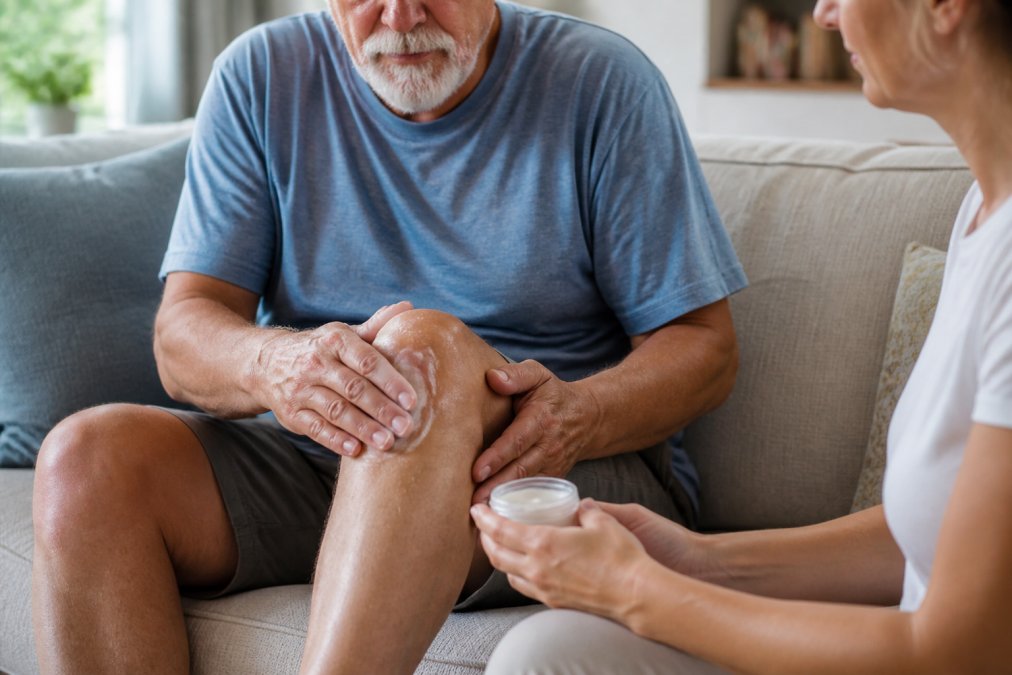
Proper application technique determines both safety and effectiveness. Start with clean, dry skin and apply a thin, even layer over the entire painful area. Rub gently until absorbed, then wash your hands immediately. Never apply topicals to broken skin, open wounds, or areas with rashes.
Dilution Ratios for DIY Topicals
If you're making your own topical blend, dilution is non-negotiable. Essential oils can cause chemical burns or allergic contact dermatitis when applied undiluted. The National Association for Holistic Aromatherapy recommends a 2% dilution for most adults, approximately 12 drops of essential oil per 1 fluid ounce (30 mL) of carrier oil. For sensitive skin, start at 1% (6 drops per ounce).
Common carrier oils include jojoba, sweet almond, fractionated coconut, and olive oil. Jojoba most closely mimics human sebum and absorbs quickly; olive oil is slower-absorbing but widely available. Avoid mineral oil or petroleum-based carriers, which sit on the skin surface and can trap heat.
For DIY cayenne pastes, capsaicin is not soluble in water, so a water-based paste will not distribute evenly. Mix cayenne powder with a carrier oil at a ratio no stronger than 1 part cayenne to 10 parts oil (roughly 1 teaspoon per 2 tablespoons oil). Even at this dilution, test on a small patch of inner forearm first.
Contraindications and Medication Interactions
Natural topicals are not automatically safe for everyone. Several common remedies interact with medications or medical conditions:
- Arnica: Do not use on broken skin or open wounds. Arnica is a known contact allergen; patch testing is essential. Avoid combining arnica gel with oral blood thinners like warfarin or aspirin, as the anti-inflammatory effect may compound bleeding risk.
- Capsaicin: If you take blood pressure medication, be aware that capsaicin cream can cause temporary localized vasodilation. More importantly, capsaicin should not be applied to the same area where you've recently used a diclofenac gel (Voltaren) or other NSAID topical, as the combination can increase systemic absorption of the NSAID.
- Menthol: Avoid menthol products if you have a history of cold sensitivity or Raynaud's phenomenon. Menthol constricts blood vessels, which can worsen circulation issues. Do not apply menthol gel immediately before exercise, the cooling sensation can mask pain signals and lead to overexertion.
- Turmeric/Curcumin: Curcumin has mild blood-thinning properties. While transdermal absorption is limited, patients on warfarin or clopidogrel should consult a physician before regular use of turmeric creams on large joint areas.
Timing and Layering Protocols
Timing matters for certain ingredients. Capsaicin works best when applied consistently at the same times daily to maintain substance P depletion. Menthol products are more flexible, suitable for use before activity or when pain spikes. For turmeric creams, apply after showering when pores are open, and wait at least 15 minutes before dressing to prevent staining.
Test any new product on a small patch of inner forearm skin for 24 hours before applying it to your knee. This simple step identifies sensitivities before you commit to a full application.
What to Avoid When Applying Topicals
Several common mistakes reduce efficacy or increase risk:
- Applying over lotion or moisturizer: This creates a barrier that prevents the active ingredient from penetrating. Apply topicals to bare skin.
- Using too much product: More is not better. A pea-sized amount for the knee joint is typically sufficient for concentrated creams; a quarter-sized amount for gels or lotions.
- Applying immediately after shaving: Shaving creates micro-abrasions that increase absorption and irritation risk. Wait at least 24 hours after shaving before applying capsaicin or menthol products.
- Covering with plastic wrap: This is dangerous with capsaicin and menthol, it can cause chemical burns. Only use breathable cotton clothing over treated areas.
- Using expired products: Essential oils oxidize over time, becoming more irritating. Check expiration dates and replace products that have changed color or developed a rancid odor.
When to Stop Using a Topical
Discontinue use and consult a healthcare provider if you experience blistering, weeping, or severe redness at the application site; pain that worsens after one week of consistent use; swelling that increases after application; or signs of allergic reaction, including hives, difficulty breathing, or swelling of the face or lips.
Topical remedies are generally well-tolerated, but they are not risk-free. Understanding your skin's sensitivity, your medication profile, and the specific properties of each ingredient is the difference between safe, effective use and a painful chemical burn or allergic reaction.
When Topicals Aren't Enough: Holistic Knee Pain Management
Topical remedies have a ceiling. If you've used a product consistently for several weeks without meaningful improvement, or if your knee pain limits daily activities, topical care alone is insufficient. Lasting relief typically requires addressing the underlying drivers: inflammation, muscle imbalances, joint mechanics, and lifestyle factors.
Weight management is arguably the most impactful holistic intervention for knee health. Every pound of excess weight adds measurable load to the knee joint during walking, and even modest reductions can noticeably ease discomfort. An anti-inflammatory diet rich in omega-3 fatty acids supports the same pathways that topical versions target.
Physical therapy and strengthening exercises build the muscles that stabilize the knee, reducing strain on cartilage and ligaments. American College of Rheumatology guidance on knee osteoarthritis management emphasizes that exercise and weight loss form the foundation of conservative knee care. For many patients, combining these approaches with professional treatment yields better results than any single remedy.
Your Next Step Toward Lasting Knee Relief
Natural topical remedies are a valuable first line of defense, but they work best as part of a comprehensive strategy rather than a standalone solution. If you've been managing knee pain with creams and gels without lasting improvement, it may be time to investigate why your knee is hurting in the first place.
At Alternative Health & Healing Center, our nearly 40 years of clinical experience informs an integrative approach that goes beyond symptom management. We combine Applied Kinesiology to identify underlying musculoskeletal imbalances with advanced technology like the Piezo Wave 2 to promote tissue healing and restore healthy joint function.
We understand the hesitation to try another provider after previous disappointments. That's why our focus is on thorough evaluation and personalized treatment plans rather than quick adjustments. Request an appointment to explore whether our technology-driven, whole-body approach can provide the lasting knee relief that topicals alone cannot deliver.
Frequently Asked Questions
What can I rub on my knee for pain?
Several natural topical options can help. Capsaicin cream, derived from chili peppers, reduces substance P, a chemical that carries pain signals to the brain. Arnica montana gel addresses inflammation and bruising. Menthol-based products create a cooling sensation that temporarily numbs the area, while turmeric cream targets swelling. For chronic knee pain, consistency matters more than which product you choose. Apply the product two to three times daily for at least two weeks to judge its effectiveness for your knee pain relief.
How does capsaicin cream for joint pain work?
Capsaicin cream works by depleting substance P, a neuropeptide responsible for transmitting pain signals from your knee joint to your spinal cord. With regular application, typically three to four times daily, the pain signal weakens over time. Initial application may cause a warming or burning sensation that usually fades within days. Studies show meaningful relief often appears after one to two weeks of consistent use. Wash your hands thoroughly after applying and avoid contact with eyes or broken skin.
What is the role of arnica montana for knee inflammation?
Arnica montana contains helenalin, a compound with anti-inflammatory properties. When applied as a gel or cream, it may help reduce swelling and bruising associated with knee strains, minor injuries, or arthritis flare-ups. Unlike menthol products that only mask pain, arnica targets the inflammatory response at the tissue level. Homeopathic preparations are widely available at pharmacies. Do not apply arnica to broken skin, and stop use if you develop a rash or irritation.
When should I see a professional for persistent knee pain?
If topical remedies haven't reduced your pain after two to three weeks of consistent use, or if you experience swelling, instability, or pain that limits daily activities, seek professional guidance. Persistent knee pain can signal underlying issues like osteoarthritis, meniscus tears, or tendinopathy that require targeted treatment. A holistic approach that combines topical remedies with chiropractic care, therapeutic exercise, and anti-inflammatory nutrition often delivers better results than any single method. A thorough evaluation helps determine which combination fits your specific condition.
Natural topical remedies offer genuine, localized relief for many types of knee discomfort, but they are tools, not cures. The most effective path to lasting knee health combines smart self-care with professional guidance that addresses the underlying causes of your pain. Get started with Alternative Health & Healing Center and discover how integrative chiropractic care can restore your mobility.