 how-to
Strengthen Core Muscles: Kinesiology Techniques Guide
Table of Contents
- Understanding Core Muscles and How They Work Together
- Core Strength Versus Visible Abdominal Muscles
- How to Engage Your Core: Muscle Activation and Breathing Coordination
- Core Strengthening Exercises for Beginners
- Progressive Core Training: Building Strength Over Time
- Core Stability Exercises and Real-World Movement
- Common Technique Errors and How to Correct Them
- When to Consult a Healthcare Professional
- Frequently Asked Questions
Last Updated: October 18, 2026
Understanding Core Muscles and How They Work Together
Your core is far more than a six-pack. It's a complex system of muscles working together to stabilize your spine, support your posture, and control movement.
The core consists of multiple layers. The outermost layer includes your rectus abdominis (the visible abdominal muscles). Beneath that lie the obliques, which wrap around your sides. Deeper still are the transverse abdominis and multifidus, your true stabilizers.
Kinesiology teaches us that these muscles don't work in isolation. They fire in specific patterns based on movement demands. When you bend forward, your deep core engages before your superficial muscles.
At Alternative Health & Healing Center, we specialize in Applied Kinesiology and have nearly 40 years of clinical experience.
Core Strength Versus Visible Abdominal Muscles
Here's what most people misunderstand: a visible six-pack doesn't equal core strength. You can have defined abdominal muscles and still have a weak, unstable core.
Visible abdominal muscles come from low body fat and training the rectus abdominis through crunches and similar movements.
The problem with chasing visible abs is that it often reinforces poor movement patterns. Endless crunches can actually weaken your deep core by encouraging excessive flexion.
True core strength shows up in real-world function. You can sit up straight without fatigue. Your back doesn't hurt after standing for hours.
The kinesiology approach prioritizes function over appearance. We train the muscles that stabilize your spine during daily activities.
How to Engage Your Core: Muscle Activation and Breathing Coordination
Most people activate their core wrong. They hold their breath and brace hard. This creates tension but not stability.
Here's how kinesiology teaches proper core engagement:
Step 1: Find Your Deep Core Lie on your back with knees bent. Place one hand on your lower belly, just inside your hip bone. Exhale slowly. You should feel a gentle tension under your hand, that's your transverse abdominis engaging. This is your deepest core muscle.
Step 2: Connect Breath to Activation Your core engages during exhalation, not inhalation. As you breathe out, your deep core naturally tightens. Don't force it.
Step 3: Maintain Engagement During Movement Once you've felt the activation, try maintaining it while you move. Lift one foot slightly off the ground.
The breathing coordination is non-negotiable. When you brace hard and hold your breath, you increase intra-abdominal pressure (pubmed.ncbi.nlm.nih.gov). This feels stable for a moment, but it's not sustainable.
This is where kinesiology differs from standard fitness training. We're not teaching you to brace.
Core Strengthening Exercises for Beginners
Start with these foundational exercises. Master the activation pattern and breathing coordination before adding difficulty. Quality of movement matters far more than quantity of repetitions.
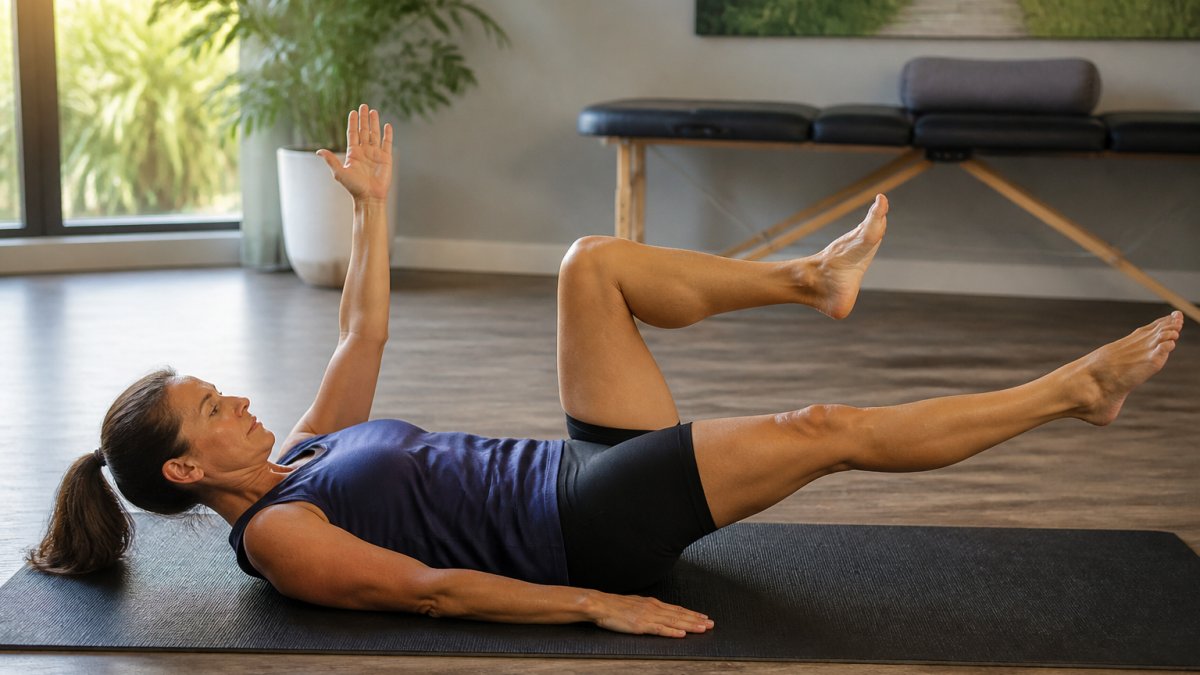
Dead Bug
The dead bug teaches core stability while your limbs move. This is one of the most effective beginner core strengthening exercises.
How to perform the dead bug:
- Lie on your back with knees bent and feet flat on the floor
- Raise your arms straight up toward the ceiling
- Lift one foot slightly off the ground, extending that leg
- Return to start and repeat on the other side
- Move slowly, this isn't a speed exercise
- Maintain steady breathing throughout
Key points:
- Your lower back should stay pressed to the floor
- Move only as far as you can while keeping your core engaged
- Exhale as you extend your leg
- Aim for 8-10 repetitions per side
Glute Bridge
The glute bridge activates your core while strengthening your glutes and posterior chain. Many people neglect their glutes, which weakens overall core stability.
How to perform the glute bridge:
- Lie on your back with knees bent and feet hip-width apart
- Press through your heels to lift your hips toward the ceiling
- Squeeze your glutes at the top
- Lower slowly back down
- Repeat for 10-12 repetitions
Key points:
- Your knees should track over your ankles
- Engage your core throughout the movement
- Don't arch your lower back excessively
- Breathe out as you lift your hips
Bird Dog
The bird dog builds core stability and teaches cross-body coordination. This exercise trains your deep core to stabilize while opposite limbs move.
How to perform the bird dog:
- Start on hands and knees
- Extend your right arm forward and left leg back
- Return to start position
- Repeat on the opposite side
- Move with control, no rushing
Key points:
- Keep your spine neutral throughout
- Your hips should stay level
- Move slowly and deliberately
- Exhale as you extend your limbs
Progressive Core Training: Building Strength Over Time
Beginners often make the same mistake: they add difficulty too fast. Real progress comes from mastering movement patterns before increasing challenge.
Exercise Progression and Regression
Every exercise exists on a spectrum. You start at a level that challenges your stability without breaking your form. As your nervous system adapts, you progress.
Progression example, Dead bug:
- Beginner: Single leg extension with arms up
- Intermediate: Opposite arm and leg extension
- Advanced: Slower tempo with longer holds
Progression example, Glute bridge:
- Beginner: Two-leg glute bridge
- Intermediate: Single-leg glute bridge
- Advanced: Single-leg glute bridge with upper back elevated
Regression example, Bird dog:
- If full bird dog is too challenging: Extend only your arm, keep your knee on the ground
- If that's still difficult: Simply lift one knee slightly without extending the opposite arm
The key is finding your starting point. You should be able to complete the movement while maintaining proper breathing and form. If you're holding your breath or your spine is moving, you've chosen a level that's too advanced.
Measuring Progress and Adjusting Your Routine
Progress isn't always visible. You won't necessarily feel stronger, but your movement quality will improve. Here's how to track real progress:
Track movement quality:
- Can you maintain neutral spine throughout the movement?
- Are you breathing steadily or holding your breath?
- Can you move with control, or are you rushing?
Track duration:
- Can you hold a position longer while maintaining form?
- Can you complete more repetitions without form breakdown?
Track consistency:
- Are you training 3-4 times per week?
- Are you performing exercises correctly each session?
Adjust your routine every 2-3 weeks. If an exercise feels easy and your form is perfect, progress to the next level. If you're struggling with form, regress to an easier variation. This isn't failure, it's smart training.
Core Stability Exercises and Real-World Movement
Core stability isn't just about lying on your back. Real strength shows up in functional movement, standing, bending, reaching, and carrying.
Functional core exercises train your stability system in positions that mimic daily life. This is where core strength becomes useful.
Standing core exercises:
- Standing marches: Lift one knee while maintaining upright posture
- Pallof press: Stand with resistance band and press away from your body
- Single-leg stance: Balance on one leg while maintaining proper posture
Carrying exercises:
- Farmer's carry: Hold weight in one hand and walk
- Suitcase carry: Hold weight at your side and walk
- Overhead carry: Hold weight overhead and walk
These exercises demand core stability because you're fighting against movement in multiple directions. Your deep core must engage to keep your spine stable while your limbs move or hold weight.
The transition from isolated core exercises to functional movement is crucial. Many people spend months doing dead bugs and planks, then struggle with real-world movement because they never trained the core to work during standing activities.
Common Technique Errors and How to Correct Them
Small errors in form compound over time. These are the mistakes we see most often.
Error 1: Holding your breath
- What it looks like: You go silent during the exercise, your face tenses
- Why it happens: Breath-holding feels stable, so people default to it
- How to fix it: Exhale as you perform the movement. Maintain steady breathing throughout.
Error 2: Moving too fast
- What it looks like: You rush through repetitions without control
- Why it happens: Speed feels like effort, so people equate it with progress
- How to fix it: Slow down. Take 2-3 seconds for each movement. Control matters more than speed.
Error 3: Excessive spinal movement
- What it looks like: Your lower back arches or your spine flexes during the exercise
- Why it happens: People don't recognize when their stabilizers fatigue
- How to fix it: Stop before you lose form. It's better to do 5 perfect repetitions than 15 sloppy ones.
Error 4: Neglecting breathing coordination
- What it looks like: You breathe inconsistently or hold your breath
- Why it happens: People focus on the movement and forget about breath
- How to fix it: Practice the breathing pattern without movement first. Once it's automatic, add the movement.
Error 5: Progressing too quickly
- What it looks like: You move to harder exercises before mastering the basics
- Why it happens: Boredom or impatience with foundational training
- How to fix it: Spend 2-4 weeks on each level before progressing. Master the pattern first.
When to Consult a Healthcare Professional
Core training is generally safe, but certain situations require professional guidance. Know when to seek help.
Consult a healthcare professional if:
- You have a history of back pain or spinal surgery
- You experience sharp pain during core exercises
- You have been diagnosed with a specific spinal condition
- You're recovering from an injury or surgery
- You have a neurological condition that affects movement
- You're unsure whether core training is appropriate for your health status
A qualified healthcare provider can assess your individual situation and recommend modifications. This is especially important if you have complex health issues or a history of injury.
At Alternative Health & Healing Center, we specialize in Applied Kinesiology and personalized movement assessment.
Core strength built through kinesiology principles creates stability that lasts. You'll notice improvements in your daily life: less back strain, better posture, improved balance, and greater confidence in movement. The exercises we've covered form a solid foundation.
Frequently Asked Questions
How do you activate your core muscles correctly?
Proper core activation starts with breath coordination. Inhale to prepare, then exhale as you gently draw your navel toward your spine without holding your breath. This engages the deep transverse abdominis muscle. The key is gentle tension, not maximum contraction. During movement, maintain this engagement while breathing normally. Common mistakes include holding your breath, over-bracing the entire abdominal wall, or failing to engage deep stabilizers. A kinesiology-informed approach focuses on motor control and muscle recruitment patterns, not just muscle tightness.
What is the difference between core strength and core stability?
Core strength refers to the ability of your abdominal and spinal muscles to generate force through movement and resistance. Core stability is the capacity to maintain spinal alignment and control trunk movement during functional activities. You can have strength without stability, or stability without maximal strength. Stability, controlled motor function and balance, is more relevant for everyday movement, posture, and back comfort. Kinesiology techniques emphasize stability and movement quality first, then build strength progressively.
How long does it take to build core strength using kinesiology techniques?
Most people notice improved trunk control and posture within 2-4 weeks of consistent practice. Measurable strength gains typically appear within 6-8 weeks. However, timeline varies based on starting fitness level, exercise frequency, and movement quality. Kinesiology-based training prioritizes proper motor patterns over speed, so early progress may feel subtle. Consistency matters more than intensity; 3-4 sessions per week for 15-20 minutes beats sporadic intense efforts. Individual factors like age, prior injury, and chronic conditions also influence progression.
Can you strengthen your core without doing sit-ups or crunches?
Yes. Sit-ups and crunches target only the rectus abdominis and can increase spinal compression, which is counterproductive for functional strength and back health. Kinesiology techniques emphasize exercises that engage the deep core, including the transverse abdominis, multifidus, and pelvic floor. Effective alternatives include dead bugs, bird dogs, glute bridges, planks, and side planks. These exercises build stability, trunk control, and balance without isolating one muscle or stressing the spine. They translate better to real-world movement and posture.