 How-to
How to Make Homemade Knee Pain Salve: 7-Step Recipe
Last Updated: October 23, 2026
Quick Summary
Make a knee pain salve by infusing 100 g carrier oil with 10 g dried ginger and 1 to 2 g cayenne for 2 to 3 hours, then straining it and melting in 15 g beeswax plus optional shea butter. Pour into tins and let set for about an hour.
- Infuse the oil at a gentle simmer, never a rolling boil, for 2 to 3 hours.
- Use beeswax at about 12 to 15 percent of the total oil-plus-wax weight.
- One batch makes roughly 120 grams, or about four 1-ounce tins.
- Patch test every new batch on your inner forearm and wait 24 hours.
- Apply a pea-sized amount per knee and wash your hands immediately after.
Table of Contents
- What You'll Need Before You Start
- How to Make Herbal Salve: Infusing the Oil
- Ginger Pain Salve Recipe: Exact Measurements
- Step-by-Step: Melting, Mixing, and Pouring Your Knee Pain Salve
- Essential Oils and Optional Additions
- Herbal Salve for Joint Pain: Application and Realistic Expectations
- Safety, Patch Testing, and When to See a Professional
- Homemade Joint Pain Relief Cream: Storage, Hygiene, and Shelf Life
- Frequently Asked Questions
What You'll Need Before You Start
Making a knee pain salve at home is simple, but results depend on the right gear and ingredients. This guide walks you through a reproducible 7-step recipe.
A knee pain salve is a topical balm made by infusing herbs into a carrier oil, then thickening it with beeswax. It is rubbed into sore knees and stiff joints for temporary relief.
Equipment and Preparation Vessels
A few basic kitchen tools cover the whole process.
- Double boiler or a glass bowl set over a pot of water
- Heat-proof jar with a lid, for infusing
- Cheesecloth or a coffee filter, for straining
The scale matters: volume scoops of beeswax vary by how packed the pastilles are, and weighing keeps every batch consistent.
Ingredients and Carrier Oils
Your carrier oil carries the herbs and does most of the skin work. Choose one that suits your skin and budget.
| Carrier Oil | Feel | Best For |
|---|---|---|
| Olive oil | Rich, slow-absorbing | Dry skin, overnight use |
| Coconut oil | Light, cooling | Warmer climates |
| Sunflower oil | Thin, neutral | Sensitive skin |
| Rice bran oil | Silky, mild | Everyday wear |
For a standard batch you also need dried ginger, cayenne pepper, and beeswax pastilles. Optional shea or cocoa butter adds body and a softer feel.
How to Make Herbal Salve: Infusing the Oil
Infusing is the heart of any herbal salve: warm the oil with dried herbs so the plant compounds move into the oil. Low heat and patience do the work.
Here is the basic method:
- Combine your carrier oil and dried herbs in a heat-proof jar.
- Set the jar in a pot with a few inches of water, forming a double boiler.
- Keep the water at a gentle simmer, never a rolling boil.
- Let it infuse for 2 to 3 hours, stirring now and then.
- Strain the oil through cheesecloth into a clean jar.
Warming Herbs: Ginger and Cayenne
Ginger and cayenne are the classic warming herbs for a ginger pain salve recipe. Both create a mild heat sensation that many find soothing for sore muscles and stiff joints.
Ground ginger is gentle and forgiving. Cayenne is stronger, so use it sparingly until you know how your skin responds, a common mistake is overdoing cayenne on the first batch.
Straining Infused Oil
Straining removes plant matter so your salve stays smooth and keeps longer. Line a fine-mesh strainer with cheesecloth or a coffee filter over a clean jar.
Pour the warm oil through slowly and do not press hard on the herbs, squeezing forces fine grit into your finished salve.
Ginger Pain Salve Recipe: Exact Measurements
Precise measurements make this recipe repeatable. Weigh in grams so every batch turns out the same, and log what you used so you can adjust next time.
This makes roughly 120 grams, or about four 1-ounce tins:
- 100 g carrier oil (olive, sunflower, or rice bran)
- 10 g dried ground ginger
- 1 to 2 g cayenne pepper (start at 1 g)
If you do not have a scale, these are approximate volume equivalents:
- 100 g carrier oil ≈ ½ cup (about 3.5 oz by volume)
- 10 g ground ginger ≈ 4 level teaspoons
- 1 g cayenne ≈ ½ level teaspoon
The oil-to-wax ratio that actually matters
The number to remember is the beeswax percentage, not the absolute grams. For a firm-but-spreadable salve, use beeswax at about 12 to 15 percent of the total oil-plus-wax weight. In the recipe above, 15 g of beeswax against 100 g of oil lands at roughly 13 percent, a good starting point for a knee salve that stays put without feeling like a candle.
Use this as a dial:
- 10 percent beeswax, soft, scoopable, best for a pump jar or cold weather
- 12 to 15 percent, standard balm consistency, good for tins
- 18 to 20 percent, firm, best for warm rooms or a salve you want to last on the skin
Adjust the beeswax, not the herbs, to change firmness. Changing the herb load changes the heat, not the texture.
Troubleshooting a batch that went wrong
- Too soft or grainy. The wax did not fully melt or you under-measured. Re-melt the whole batch gently and stir in 1 to 2 g more beeswax, then re-test.
- Too firm or waxy. Add carrier oil 5 g at a time, re-melt, and re-test. Do not add water, water in an oil-based salve invites spoilage.
- Gritty texture. Fine herb particles passed through the strainer. Re-melt and strain again through a double layer of cheesecloth.
Beeswax and Salve Consistency
Beeswax sets the salve and controls firmness: more means a firmer balm, less a softer cream.
Start with about 15 g of beeswax per 100 g of oil. Test salve consistency by dripping a drop onto a cold spoon: if too soft, stir in more beeswax; if waxy, add a splash of oil.
Step-by-Step: Melting, Mixing, and Pouring Your Knee Pain Salve
Final assembly takes about 15 minutes. Melt slowly and stir gently so the salve stays smooth.
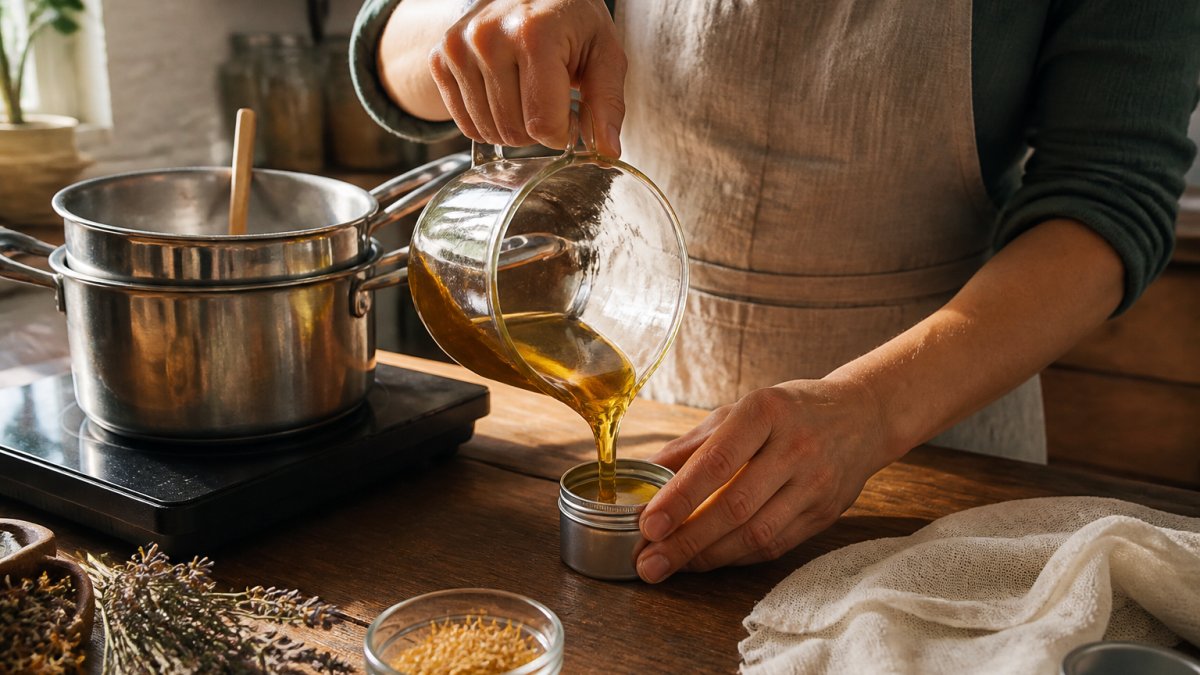
- Melt the beeswax. Set your double boiler to low heat and melt the beeswax pastilles.
- Add the infused oil. Pour in your strained herb-infused oil and stir to combine.
- Add butters if using. Stir in shea or cocoa butter until fully melted.
- Check firmness. Drip a drop onto a cold spoon and let it cool.
- Adjust. Add more beeswax for firmness or oil for softness.
- Pour. Carefully pour into clean tins or jars.
- Cool. Let them set undisturbed for about an hour.
Label each tin with the date, an identified salve gets used; an unlabeled one gets forgotten.
Essential Oils and Optional Additions
Essential oils add scent and a cooling or warming feel, but they are optional. Skip them if your skin is sensitive.
Good choices for a herbal salve for joint pain include:
- Peppermint for a cooling sensation
- Lavender for a calm scent
- Eucalyptus for a fresh, menthol-like feel
Add essential oils after removing the salve from the heat, heat burns off the scent. Use a few drops per tin and always patch test first.
If you want to build a fuller routine around herbs, see our guide to safe herbal supplements for long-term joint health.
Herbal Salve for Joint Pain: Application and Realistic Expectations
A salve is a comfort tool, not a cure. Used well, it can ease everyday soreness around the knee. It will not repair cartilage, reverse osteoarthritis, or replace an evaluation for a mechanical problem.
How to apply it to the knee
A pea-sized amount per knee is usually enough to start. Warm it between your fingers, then massage into the skin around the joint, front of the kneecap, sides, and soft tissue above and below, rather than pressing hard on the kneecap.
Timing matters more than most guides admit:
- After a warm shower or bath. Clean, slightly damp skin absorbs a salve more evenly, and the warmth can make the massage more comfortable.
- Before bed. A salve plus gentle massage fits naturally into a wind-down routine and avoids transferring the product to clothing during the day.
- Before light activity, not intense activity. If you use a warming salve with cayenne, apply it 15 to 20 minutes before a walk or gentle mobility work so the heat sensation has settled.
Wash your hands immediately after applying and avoid touching your eyes, nose, or mouth until you have. If applying to someone else, use a spatula or disposable glove, cayenne transfers easily to sensitive skin.
What the evidence does and does not support
Be skeptical of any page promising a homemade salve will 'reverse' knee pain. The honest picture is more modest:
- Cayenne (capsaicin). Capsaicin is the best-studied warming ingredient in topical products. It works by depleting substance P, a neurotransmitter involved in pain signaling, which is why the heat sensation fades with repeated use. Over-the-counter capsaicin creams are recognized in mainstream practice for temporary relief of minor aches, but the concentration in a homemade salve is not standardized, so effects vary batch to batch.
- Ginger. Ginger contains gingerols and shogaols that produce a mild warming sensation. Topical ginger is traditional and generally well tolerated, but rigorous clinical evidence for a homemade infused oil is limited. Treat it as a comfort ingredient, not a proven therapy.
- Peppermint and other essential oils. Menthol produces a cooling sensation that can distract from soreness. The effect is sensory and temporary.
Expect temporary relief of everyday stiffness and a soothing ritual that supports rest, not a fix for joint damage or all-day relief.
What a salve can and cannot do for a knee
| A salve may help with | A salve will not fix |
|---|---|
| Mild morning stiffness | Cartilage wear or osteoarthritis |
| Soreness after activity | Ligament or meniscus injury |
| A comforting massage routine | Instability or a knee that gives way |
| Temporary warming or cooling sensation | Swelling from an infection or flare |
A salve works best as one part of a bigger plan. Our article on natural topical remedies for knee pain relief covers what else works, and our guide to lifestyle changes to reduce chronic joint inflammation explains what supports relief from the inside.
Safety, Patch Testing, and When to See a Professional
Patch test every new batch before using it on your knee: apply a small amount to your inner forearm and wait 24 hours. If you see redness, itching, or swelling, stop.
Do not use a salve as a substitute for medical care. See a professional if you notice:
- Knee pain that lasts more than a few weeks
- Swelling, redness, or warmth around the joint
- Pain that wakes you at night
If knee pain persists despite home care, it may be time to look at other options. Our guide to chiropractic care for knee arthritis pain explains how a professional evaluation works. For readers who want drug-free options, our overview of non-invasive therapy for joint pain covers therapies that go beyond home remedies.
At Alternative Health & Healing Center, we combine nearly 40 years of clinical experience with an integrative approach. Our team uses Applied Kinesiology and advanced tools like the Piezo Wave 2 to assess and treat musculoskeletal and nerve pain.
Homemade Joint Pain Relief Cream: Storage, Hygiene, and Shelf Life
A homemade joint pain relief cream lasts longer when kept clean and cool. Store tins in a dark, cool place away from sunlight and heat.
Follow these habits:
- Use clean, dry fingers or a small spatula to scoop
- Keep water out of the tin
- Label each batch with the date
Most oil-based salves keep for several months when stored well. Batches with fresh ingredients spoil faster. Make small batches and use them up.
Knee pain that keeps coming back is a signal worth listening to.
Frequently Asked Questions
What is the best homemade remedy for knee pain?
A warming salve made with ginger or cayenne infused into a carrier oil and set with beeswax is a common homemade option for knee discomfort. The heat from these herbs can feel soothing on sore, stiff joints. Apply a small amount to clean skin and massage gently. Pair it with rest, gentle movement, and ice or heat as needed. If knee pain is severe, persistent, or comes with swelling or instability, see a healthcare professional before relying on any topical remedy.
How do you make a homemade herbal salve for joint pain?
Start by infusing dried herbs like ginger or cayenne into a carrier oil such as olive or sunflower oil using low heat for two to three hours. Strain the oil through cheesecloth, then combine it with beeswax pastilles in a double boiler until melted. Stir well, pour into a heat-proof jar or tin, and let it cool completely. A typical ratio is about 1 ounce of beeswax per 8 ounces of infused oil, adjusted for your desired firmness.
How should you apply a homemade salve to a sore knee?
Wash and dry the skin around your knee first. Do a patch test on a small area 24 hours before full use, especially with cayenne or essential oils. Apply a thin layer of salve and massage it in gently for a minute or two. Wash your hands thoroughly afterward and avoid touching your eyes. Use it two to three times daily as needed, and stop if you notice redness, burning, or irritation.
Can a homemade salve relieve arthritis-related knee pain?
Topical salves with warming herbs may provide temporary comfort for mild arthritis-related knee stiffness, but they do not treat the underlying joint condition. Evidence for herbal ingredients is limited and results vary. A salve can be part of a broader self-care routine alongside movement, weight management, and professional care. If arthritis pain is worsening or limiting daily activity, consult a qualified healthcare provider for a proper assessment and treatment plan.