 How-to
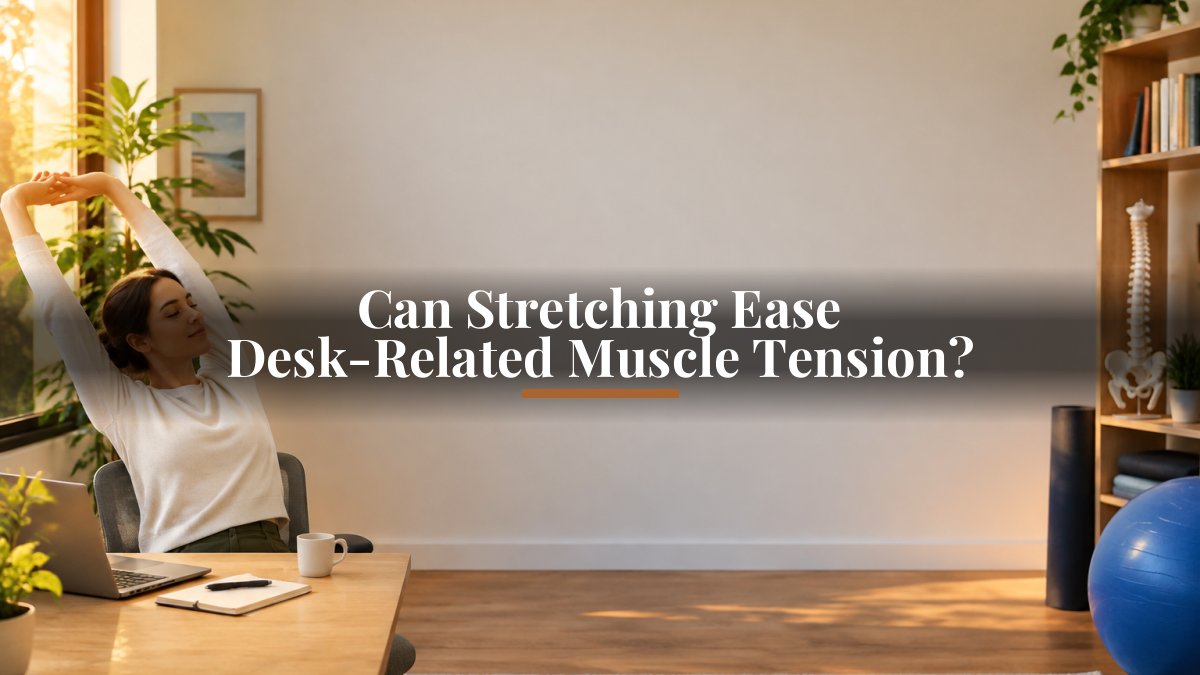
Can Stretching Ease Desk-Related Muscle Tension?
Last Updated: November 17, 2026
Quick Summary
Desk stretches are short, deliberate movements performed at or near your workstation to loosen tight muscles, ease stiffness, and restore range of motion after prolonged sitting. A five-minute routine done once in the morning and once in the afternoon targets your neck, shoulders, back, and wrists, and requires no equipment.
- Hold each static stretch for 15 to 30 seconds and repeat 2 to 4 times per side.
- Stand and move at least once every hour, walking for 1 to 2 minutes.
- Set your monitor so the top of the screen sits at eye level.
- Stop a stretch if you feel sharp pain, numbness, tingling, or weakness.
- Seek a professional assessment if pain lasts more than a few weeks despite stretching.
Table of Contents
- Why Desk Stretches Matter for Muscle Tension
- 5-Minute Stretches for Office Workers: A Timed Routine
- Neck, Shoulder, and Upper-Back Desk Stretches
- Office Stretches for Lower Back Pain
- Wrist and Forearm Mobility for Keyboard Work
- Ergonomic Exercises for Office Workers and Workstation Setup
- How Often to Stretch, What to Expect, and When to Get Help
- Request an Appointment for Persistent Tension
- Frequently Asked Questions
Why Desk Stretches Matter for Muscle Tension
Prolonged sitting keeps muscles in a shortened position for hours. Over time, that stillness leads to stiffness, aches and pains, and reduced range of motion. This guide explains how simple desk stretches can ease that buildup and help you feel better during the workday.
Desk stretches are short, deliberate movements performed at or near your workstation to loosen tight muscles, ease stiffness, and restore range of motion after prolonged sitting. They take only minutes and require no equipment.
The problem is not just soreness. When you sit all day, your hip flexors shorten, your shoulders round forward, and your neck drifts into a forward position. Movement breaks interrupt that pattern.
Below, we'll show you exactly how to build a routine that fits a real workday, with timing, safety guidance, and workstation tips. The American Chiropractic Association's guidance on workplace wellness supports regular movement breaks for office workers.
5-Minute Stretches for Office Workers: A Timed Routine
A five-minute routine works best when you move through each area in order, holding each stretch long enough to loosen tight muscles without forcing anything.
Try this sequence once in the morning and once in the afternoon:
- Neck stretch - 20 seconds per side
- Shoulder shrug - 10 slow reps
- Seated spinal rotation - 20 seconds per side
- Overhead reach - 20 seconds
- Wrist and forearm mobility - 20 seconds per hand
- Standing back extension - 15 seconds
Total time: about five minutes. Set a timer so you do not rush. Breathe steadily and hold each stretch at a point of gentle tension, never pain. A common mistake is bouncing; slow, steady holds work better.
This five-minute sequence moves through each area in order, and you can run it once in the morning and once in the afternoon. For more desk exercises that improve spinal alignment, try these.
| Stretch | Time or reps |
|---|---|
| Neck stretch | 20 seconds per side |
| Shoulder shrug | 10 slow reps |
| Seated spinal rotation | 20 seconds per side |
| Overhead reach | 20 seconds |
| Wrist and forearm mobility | 20 seconds per hand |
| Standing back extension | 15 seconds |
Hold times for each stretch in the 5-minute desk routine
Neck, Shoulder, and Upper-Back Desk Stretches
These three areas carry most of the load from keyboard work and screen time. Tight muscles here often refer discomfort into the head and upper back.

Neck Stretch and Head Glide
For the neck stretch, sit up straight and tilt your head toward one shoulder until you feel a stretch along the opposite side. Hold the stretch for 20 seconds, then repeat on the other side.
The head glide targets forward head posture. Pull your chin straight back, as if making a double chin, and hold for five seconds. Repeat ten times.
Shoulder Shrug and Posterior Shoulder Stretch
Shoulder shrugs are simple: raise both shoulders toward your ears, hold for three seconds, then release. Do ten slow reps to release tension.
For the posterior shoulder stretch, bring one arm across your chest and gently pull it closer with the other hand. Hold for 20 seconds per side. A triceps stretch, with one hand reaching down your upper back, complements it well.
Upper-Back Overhead Reach and Seated Spinal Rotation
The overhead reach opens the upper back. Clasp your hands, reach them overhead, and lean gently to each side for 20 seconds.
Seated spinal rotation keeps the mid-back mobile. Sit tall, cross your arms, and rotate your torso to one side. Hold for 20 seconds, then switch sides. Keep your hips square and move slowly.
Office Stretches for Lower Back Pain
Gentle movement is commonly suggested for lower-back discomfort from sitting.
Work through these in order. Each one can be done seated or standing, so pick the version that fits your workspace and your comfort level.
1. Seated forward fold (seated version) Sit tall at the front edge of your chair with feet flat on the floor.
2. Standing forward fold (standing version) Stand with feet hip-width apart and knees slightly bent.
3. Standing back extension Stand with feet hip-width apart and place your hands on your lower back, fingers pointing down.
4. Hamstring stretch (seated version) Sit at the edge of your chair and extend one leg forward with the heel on the floor and toes pointing up.
**5.
6. Hip flexor stretch (standing) Stand and step one foot back about two feet, keeping the back heel lifted.
7. Seated knee-to-chest (limited-mobility option) If standing is difficult, sit in your chair and bring one knee toward your chest, holding it with both hands.
Watch out: if a stretch sends sharp pain down your leg, worsens numbness or tingling, or produces pain that lingers after you stop, do not push through it.
Pairing stretches with a standing or walking break can help reduce how quickly stiffness returns after sitting again.
Wrist and Forearm Mobility for Keyboard Work
Wrist pain builds quietly during long typing sessions. Wrist and forearm mobility work keeps the joints and tendons moving and can ease discomfort before it settles in.
Start with gentle circles: rotate each wrist ten times in each direction. Next, extend one arm and gently pull the fingers back to stretch the forearm, holding for 20 seconds. Then turn the palm down and pull the hand toward you for another 20 seconds.
Finally, make a loose fist, then spread the fingers wide. Repeat ten times. These movements take under a minute and pair well with any movement break.
Ergonomic Exercises for Office Workers and Workstation Setup
Stretching helps, but it cannot undo a workstation that forces poor posture all day. Ergonomic exercises for office workers work best alongside a proper setup. Here is a general approach to setting up a workstation: A well-adjusted desk can help reduce the strain that builds up during the workday, and Ergo Desks are one option to consider when addressing back pain at work.
- Set your monitor so the top of the screen sits at eye level
- Keep your elbows near 90 degrees, with wrists flat
- Place feet flat on the floor or on a footrest
- Keep the keyboard close enough that your shoulders stay relaxed
- Stand and move at least once every hour
For a fuller walkthrough, see our guide to an ergonomic home office setup for back pain. If you are adjusting a sit-stand desk, our step-by-step guide on how to set up a standing desk correctly covers height and posture. Readers weighing chair options can read which ergonomic chair works best for chronic muscle tension.
How Often to Stretch, What to Expect, and When to Get Help
Most people do best with short, frequent sessions rather than one long one. The schedule below is a practical starting point, not a rule. Adjust it to your workday and your body.
A realistic daily schedule
- Every 30 to 60 minutes: stand up, walk for 1 to 2 minutes, and do one or two of the stretches above. A single neck stretch or shoulder shrug counts.
- Mid-morning: run the full 5-minute routine from earlier in this guide.
- Mid-afternoon: run the full 5-minute routine again.
- End of workday: 2 to 3 minutes of hip flexor and hamstring work before you leave your desk.
That adds up to roughly 15 to 20 minutes of movement spread across the day. Set a timer or calendar reminder for the hourly break; most people underestimate how long they sit without moving.
Hold times and reps Hold each static stretch for 15 to 30 seconds and repeat 2 to 4 times per side. For dynamic movements like shoulder shrugs, wrist circles, and head glides, do 8 to 10 slow reps. Breathe steadily throughout; holding your breath works against the relaxation you are trying to create.
What to expect The relief is usually temporary, though. Stretching may ease tension and support range of motion, but it is not a substitute for addressing an underlying injury, a disc problem, or a workstation that forces poor posture all day.
When to stop and when to get help Stop a stretch if you feel sharp pain, numbness, tingling, or weakness in the arms or legs, or if the stretch makes your symptoms worse rather than better. Never force a stretch to the point of pain; gentle tension is the target.
Seek a professional assessment if you notice:
- Pain that lasts more than a few weeks despite consistent stretching and movement breaks
- Numbness, tingling, or weakness in the arms or legs
- Pain that wakes you at night
- Headaches that keep returning
- Pain that follows an injury or a fall
A qualified professional can assess what may be driving the tension and whether other causes need attention. The Occupational Safety and Health Administration's guidance on ergonomics notes that early reporting of discomfort helps prevent longer-term problems, which is why it is worth acting on persistent symptoms rather than waiting them out.
Request an Appointment for Persistent Tension
Stretching is a strong first step, but persistent tension sometimes needs more than a movement break. At Alternative Health & Healing Center, we combine nearly 40 years of clinical experience with an integrative approach, including Applied Kinesiology and advanced technology such as the Piezo Wave 2, to address musculoskeletal and nerve pain.
If shoulder tension keeps returning, our overview of non-invasive therapy for shoulder tension covers drug-free options. When self-care is not enough, a proper assessment can clarify what is really driving the discomfort.
If desk stretches have not resolved your tension, it may be time to look deeper. Alternative Health & Healing Center offers personalized chiropractic care, Applied Kinesiology, and therapies such as the Piezo Wave 2 to help you move with less pain. Get started with Alternative Health & Healing Center and request an appointment to build a plan for lasting relief.
Frequently Asked Questions
Can stretching help with muscle tension caused by prolonged sitting?
Desk stretches can ease stiffness and tight muscles that build up during prolonged sitting, and they give your joints a movement break from a fixed posture. They work best as part of a routine: a short set of desk stretches every hour or two, paired with standing up and adjusting your workstation. Stretching may ease discomfort but is not a substitute for addressing an underlying injury, so ongoing neck, shoulder, or back pain that does not improve deserves a professional evaluation.
How often should I do 5-minute stretches for office workers during the day?
A practical pattern is one 5-minute round every 60 to 90 minutes of sitting, plus a longer session at the start or end of the workday. Hold each stretch for about 20 to 30 seconds and repeat on the other side. Short, frequent movement breaks are a common approach for reducing stiffness during the workday. If a stretch causes sharp pain, stop and mention it at your next appointment.
What are the most effective office stretches for lower back pain?
Seated spinal rotation, a gentle standing back extension, and a seated hamstring stretch cover most of the lower back. Sit tall in your desk chair, rotate slowly to one side and hold, then repeat on the other side. Follow with a standing extension by placing your hands on your hips and leaning back slightly. These office stretches for lower back pain can be combined with an ergonomic chair setup and regular standing breaks.
What ergonomic exercises for office workers complement a stretching routine?
Beyond stretching, add shoulder shrugs, chin tucks, and wrist and forearm mobility drills to offset keyboard and mouse work. Set your monitor at eye level, keep feet flat, and support your lower back. Take a movement break every hour. If tension keeps returning despite these habits, a professional assessment can help clarify what may be contributing to it.